

Creative convergence: exploring biocultural diversity through art
From Abstract: "Using multiple knowledge sources to interpret patterns of biodiversity can generate the comprehensive species characterizations that are required for effective conservation strategies. Caribou (Rangifer tarandus) display substantial intraspecific variation across their distribution and in the Sahtú Region of the Northwest Territories, Canada, three caribou types, each with a different conservation status, co-occur. Caribou are essential to the economies, culture, and livelihoods of northern indigenous peoples. Indigenous communities across the north are insisting that caribou research be community-driven and collaborative. In response to questions that arose through dialogue with five Sahtú Dene and Métis communities, we jointly developed a research approach to understand caribou differentiation and population structure. Our goal was to examine caribou variation through analysis of population genetics and an exploration of the relationships Dene and Métis people establish with animals within bioculturally diverse systems. To cultivate a research environment that supported łeghágots'enetę “learning together” we collaborated with Ɂehdzo Got'ı̨nę (Renewable Resources Councils), elders, and an advisory group. Dene knowledge and categorization systems include a comprehensive understanding of the origin, behaviors, dynamic interactions, and spatial structure of caribou. Dene people classify tǫdzı “boreal woodland caribou” based on unique behaviors, habitat preferences, and morphology that differ from ɂekwę́ “barren-ground” or shúhta ɂepę́ “mountain” caribou. Similarly, genetic analysis of material (microsatellites and mitochondrial DNA) from caribou fecal pellets, collected in collaboration with community members during the winter, provided additional evidence for population differentiation that corresponded to the caribou types recognized by Dene people and produced insights into the evolutionary histories that contribute to the various forms. We developed culturally respectful and relevant descriptions of caribou variation through partnerships that respect the lives and experiences of people that depend on the land. By prioritizing mutual learning, researchers can broaden their understanding of biodiversity and establish a common language for collaboration."
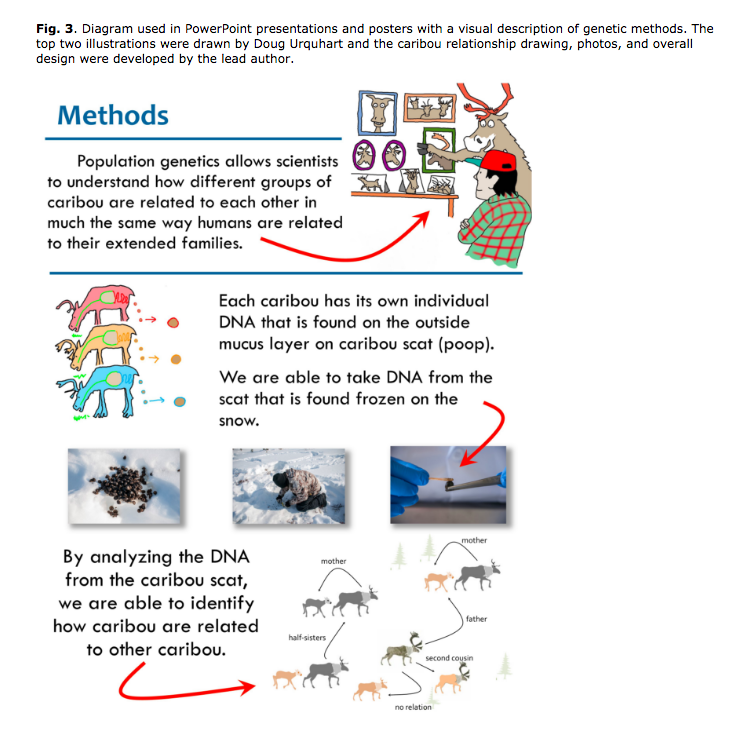
Image from article.
Access this Resource:
The full text of this article is available at: https://www.ecologyandsociety.org/vol22/iss2/art4/
Polfus, Jean, Deborah Simmons, Michael Neyelle, Walter Bayha, Frederick Andrew, Leon Andrew, Bethann Merkle, Keren Rice, and Micheline Manseau. “Creative convergence: exploring biocultural diversity through art.” Ecology and Society 22, no. 2 (2017).
Land-based Practice for Indigenous Health and Wellness in Yukon, Nunavut, and the Northwest Territories
Redvers’ thesis focuses on the growing frequency of land-based practice (e.g. on the land youth programs) in Aboriginal settings, its potential for revitalization, wellbeing, and youth resilience, and the value of land-based practice for other activities such as research. She begins to address a gap in the literature regarding the development, implementation, and evaluation of land based practices.
Redvers’ work describes the health benefits and other positive outcomes that being on the land (and spending more time there) can have for all generations of people. As her work is framed, in part, as a response to high suicide rates in northern Canada, she has a particular emphasis on youth resilience. Redvers works with a land-based understanding that sees the land itself as healing. This has been traditionally known for a long time and only recently has been complemented by biomedical research. Not only does being on the land improve cultural, social, physical, and psychological wellbeing, it also promotes land stewardship, intergenerational transmission of knowledge, enhanced learning, capacity building, language transfer, and good training for non-Indigenous researchers.
From Abstract: "This thesis examines the cultural concept and role of the Land as healer in Indigenous communities in the Northwest Territories, Yukon, and Nunavut, and the importance of facilitating modern Land-based programs and activities for integrated health, education, and environmental outcomes. It describes a yet largely undefined field of professional practice currently being negotiated on the ground in communities. This valid form of integrative practice, centered in Indigenous pedagogy and wisdom, recognizes that people are intimately interwoven and connected with their traditional lands, and that directly cultivating this fundamental relationship can shape and influence all areas of interaction with society, including our health and wellness. Research methods were framed by an Indigenous methodology of narrative experience. Eleven Land-based practitioners were interviewed, and their narratives speak to the recognition of Land practice as an important part of individual and community resilience in the face of rapid colonial change and its subsequent challenges."
Access this Resource:
This PDF is fully accessible at: https://static1.squarespace.com/static/5626b5ebe4b0fcee4754da16/t/5a85e5f0f9619af725504557/1518724596509/Jennifer_redvers_Thesis_2016.pdf
For an alternative source, in case of a broken link, see: http://hdl.handle.net/11023/2996
Redvers, Jennifer. Land-based Practice for Indigenous Health and Wellness in Yukon, Nunavut, and the Northwest Territories. Master’s Thesis, University of Calgary, 2016.
CMEC Aboriginal Educators’ Symposium, Summary Report
The CMEC Aboriginal Educators’ Symposium took place in Yellowknife, NT from June 29-30, 2015. It discussed “how to attract more Aboriginal people to teaching careers; how to encourage existing Aboriginal educators to remain in the profession; how to support Aboriginal students entering the field of education; and, how to support all Aboriginal educators in their training and career development” (1).
Read more about this event: https://www.cmec.ca/530/CMEC_Aboriginal_Educators%E2%80%99_Symposium.html
Access this Resource:
Click the link below for the open access PDF from the CMEC website.
Sahtú Environmental Research and Monitoring Forum Activity Report 2015-2016
From Report: The Sahtú Environmental Research and Monitoring Forum was initiated in 2013 to support environmental research and monitoring by providing a venue for discussing plans and accommodating the priorities and traditional knowledge of Sahtú communities. Through fostering communications between forum members, which include community, regional, territorial and federal government representatives as well as industry representation, forum members hope to ensure that “environmental monitoring and research programs and projects in the Sahtú are coordinated and conducted in ways that reflect regional and community priorities, engage communities, value both western science and traditional knowledge, and support wise decision-making.” Achievements from this reporting period included environmental research and monitoring workshops, research results workshops, and publications.
Access this Resource:
See the PDF attachment at the bottom of the page
Wenman, Christine. Sahtú Environmental Research and Monitoring Forum 2013-2015 Update Report. Tulıt’a: PlanIt North, 2015.
Annual Report on Official Languages 2015-2016
Every fiscal year, the Government of the Northwest Territories issues a record of measures taken to implement the Official Languages Act. Each report details developments in both French and Aboriginal language programming. Many programs focus on connecting youth with elders, training teachers, developing curriculum, and providing government services in as many languages as possible.
Some events from this reporting period:
- Describes language plan and notes that ECE is currently working on an updated version for 2015-2020.
- The North Slavey member of the Official Languages Board was Theresa Etchinelle, with Jane Modeste as alternate. For the Aboriginal Language Revitalization Board, it was Dora Grandjambe with Anne Kochon-Orlias as alternate.
- The boards are currently developing a process for amalgamation, which will require amendments to the Official Languages Act.
- The report summarizes the TRC Calls to Action specific to language and culture. It identifies points that it is already undertaking and commits to calling on the federal government for Aboriginal language revitalization funding.
- It then presents one page summaries of each language region’s five year plan, with updates and highlights of 2015-16.
Access this Resource:
The Government of the Northwest Territories makes reports from the last decade available here: https://www.ece.gov.nt.ca/en/services/francophone-affairs-secretariat/official-languages-annual-reports
Government of the Northwest Territories. Annual Report on Official Languages. Yellowknife: 2016.
Ets’ulah: “The language is like ets’ulah"
Ets’ulah is Dene Love Song, a neglected musical form that Laura Tutcho argues can be used to revitalize the Sahtúgotı̨nę language. Ets’ulah is “one of the oldest traditions for representing kinship links, family legacies, and ties to the land and life on the land.” (6) Laura Tutcho begins by presenting an overview of Dene history, and the importance of Dene language to knowing “who we are as people” (9) today. The history of the residential schools and the different attitudes of traders, missionaries, and teachers towards Dene language and culture are also presented. Next, the author talks about the current status of language teaching in Délı̨nę, making some key points:
- She recommends a bilingual upbringing that teaches children the language and also encourages graduation.
- She talks about a “cultural inclusion program” (12) that teaches children to drum, sing Slavey songs, sew, and survive on the land.
- She identifies a dire need for more Sahtú Dene teachers and recommends that the Délı̨nę Self Government priorities include a “strong position about how our children and people should be taught.” (13)
- She comments that Canadian laws, mǫ́la ɂeɂá, “can never do justice to our way of knowing.” (17)
The author talks about her own story, moving from the land to a formidable English day school at the age of 8 and needing to speak English to avoid the strap. She talks about the lessons she learned in her community and some of the traditions she remembers about hunting, taboos, and other teachings. One central question she addresses is how to engage youth in learning the same knowledge, particularly their Dene language. She sees ets’ulah as one way to get youth interested in Dene Kedǝ and Dene Ts’ı̨lı̨.
From Abstract: "My project is about how ets’ulah (Dene love song) can contribute to the revitalization of Sahtúgot’ı̨nę language. The Sahtúgot’ı̨nę language is spoken in the community of Délı̨ ne, Northwest Territories. My research highlights the Sahtúgot'ine tradition of ets'ulah, a musical form that will entice young people to use their language. Ets'ulah is the most neglected of the musical expressions of culture, yet one of the oldest traditions for representing kinship links, family legacies, and ties to the land and life on the land. I provide a study of noted singer the late Eliza Blondin to help revitalize Sahtúgot’ı̨ nę language through the value of ets'ulah, for as Besha Blondin, Eliza’s daughter, says, “the language is like ets’ulah”."
Read other University of Victoria Language Revitalization MA Theses from Susan Saunders and Fibbie Tatti.
Access this Resource:
This thesis has been made available open access by the University of Victoria: https://www.uvic.ca/education/indigenous/assets/docs/Tutcho_Laura_MEd_2016.pdf
Read more Masters in Indigenous Languages Revitalization Theses and Projects from UVic here: https://www.uvic.ca/education/indigenous/research/graduate/index.php
Tutcho, Laura. Ets’ulah: “The language is like ets’ulah.” Master’s Thesis, University of Victoria, 2016.
Time and Story in Sahtú Self Government: Intercultural Bureaucracies on Great Bear Lake
Rice’s thesis explores Délı̨nę at the time of transition to self-government (2015). It describes the community’s hopes for self government’s future, the history that lead to its negotiation, the ways in which a legal agreement’s text may diverge from the ideas people hold about it, and the ways in which people are impacted by the new roles created by institutions of governance.
In many ways, Dene Ts’ı̨lı̨ has the power to transform Canadian institutions and laws, as in when Dene SSI board members in Délı̨nę use Dene Kedǝ to change the mood and content of an otherwise sterile meeting, and remind their leaders of their Dene origins. Dene understandings of the Final Self Government Agreement are different than the text itself: its oral life has different power in Délı̨nę than the written document, and opportunities for the FSGA to be a vehicle for Dene Ts’ı̨lı̨ and Dene Kedǝ lie in people’s hopes and plans for the future. In 2015, the mere idea of self-government had generated significant energy and planning around Dene Ts’ı̨lı̨ and Kedǝ preservation and revitalization.
From Abstract: "This thesis explores aspects of self-government in Délı̨nę, NT, Canada, a Sahtú Dene community of approximately 550 people. Délı̨nę’s Final Self Government Agreement (FSGA) was passed by the federal government of Canada in 2015, and the research for this thesis coincided with the beginning of Délı̨nę’s one-year transition into self government. The FSGA follows the Sahtú Dene and Métis Comprehensive Land Claim Agreement of 1993, and the region falls within Treaty 11. This thesis’ primary question is: What are the shared stories about the future of self-government that people in Délı̨nę tell? Subsidiary questions and themes that emerged from the research process include: How does the history of the Sahtú region inform contemporary negotiations, agreements, and the stories told about them? How do new roles created by institutions of governance impact the people who hold them? How does the text of a self-government agreement diverge from the ideas that people have about self-government?"
Access this Resource:
This thesis has been made available open access from the University of Alberta here: http://hdl.handle.net/10402/era.43158
Rice, Faun. Time and Story in Sahtú Self Government: Intercultural Bureaucracies on Great Bear Lake. Master’s Thesis, University of Alberta, 2016.
Belare Wı́le Gots'ę́ Ɂekwę́ - Caribou for All Time: A Délı̨nę Got’ı̨nę Plan of Action
This is a traditional Caribou management plan, approved by Délı̨nę First Nation, Land Corporation and Ɂehdzo Got'ı̨nę. It is the first plan of its kind in Canada. After a formal public hearing, the plan was also approved by the SRRB and subsequently by the GNWT Minister of Environment and Natural Resources.
Access this Resource:
This resources is available elsewhere on the SRRB Website. Or, download the PDF from the attachment at the bottom of this page.
Délı̨nę Ɂekwę́ Working Group. Belare Wı́le Gots’ę́ Ɂekwę́ – Caribou for All Time. Délı̨nę : Délı̨nę Ɂekwę́ Working Group, 2016.
Social determinants of health for the off-reserve First Nations population, 15 years of age and older, 2012
This paper summarizes numerous health statistics and indicators for off-reserve First Nations people. However, the most relevant items for this study are the impact of language, culture, and community identity on health. For context, off-reserve First Nations people 15 or older most commonly report: blood pressure complications, arthritis, and asthma, and 10% of off-reserve First Nations people experience Diabetes. 60% of First Nations people off-reserve “report very good mental health, compared with 72% of the total Canadian population.” (7) Mental health issues were more common in women than in men.
Rotenberg cites Reading and Wien (2009) as a demonstration that cultural community and continuity influence proximal health indicators such as smoking or poverty. Additionally, Rotenberg uses data from participation in hunting, fishing, trapping, etc. (from the Aboriginal Peoples’ Survey 2012) as a proxy for cultural continuity/connectedness. Approximately 62% of off-reserve First Nations People over 15 participated in a traditional activity (as defined and limited by the survey) in 2011. This was not found to be a productive factor; in fact, people who participated in traditional activities were more likely to have a chronic condition. Similarly, the APS did not demonstrate “a significant association between Aboriginal language speaking abilities and any of the three negative health outcome variables analyzed after controlling for various factors.” (16) This study uses health indicators such as having a personal physician: results likely depend significantly on how health is measured. For example, people who reported being able to turn to friends or family in times of crises were far more likely to have better overall health than those who had no-one to turn to. Strong family ties do have a significant impact on health.
Access this Resource:
This study is available for free on the Statistics Canada website: https://www.statcan.gc.ca/pub/89-653-x/89-653-x2016010-eng.htm
Rotenberg, Christine. “Social determinants of health for the off-reserve First Nations population, 15 years of age and older, 2012.” Statistics Canada. Catalogue no. 89-653 (2016).
Łeghágots' enetę (learning together): the importance of indigenous perspectives in the identification of biological variation
From Abstract: Indigenous communities across the north are insisting that caribou research be community-driven and collaborative. In response to questions that arose through dialogue with five Sahtú Dene and Métis communities, we jointly developed a research approach to understand caribou differentiation and population structure.
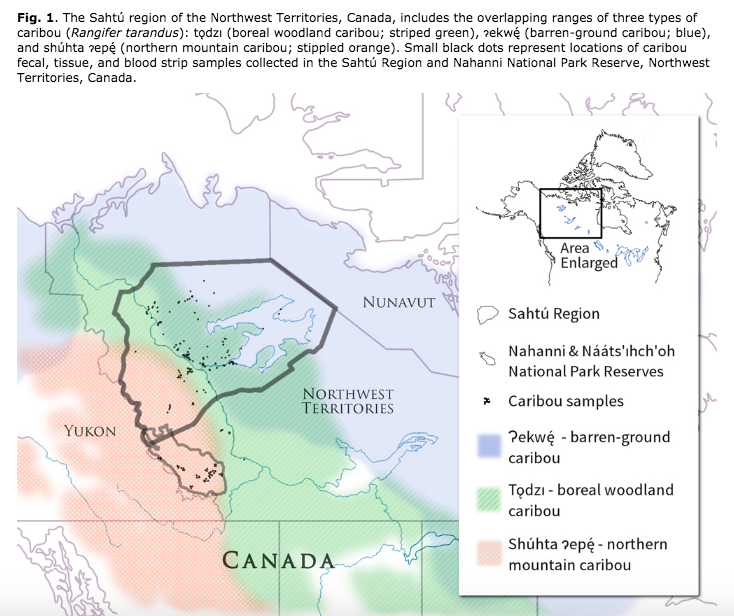
Image from article.
Read more about this research.
Access this Resource:
The full text of this paper is available on the Ecology and Society website: https://www.ecologyandsociety.org/vol21/iss2/art18/
The SRRB hosts a PDF (downloadable at the bottom of this page), available through a Creative Commons 4.0 Non-Commercial Attribution, https://creativecommons.org/licenses/by-nc/4.0/legalcode
Polfus, Jean, Micheline Manseau, Deborah Simmons, Michael Neyelle, Walter Bayha, Frederick Andrew, Leon Andrew, Comelya Klütsch, Keren Rice, and Paul Wilson. “Łeghágots' enetę (learning together): the importance of indigenous perspectives in the identification of biological variation.” Ecology and Society 21, no. 2 (2016): 18.
 Phone: 867-374-4041
 Email: