
Creating Able Human Beings: Social Studies Curriculum in the Northwest Territories and Nunavut, 1969 to the Present
McGregor examines social studies curricula from the point of transfer of responsibility for education to the Northwest Territories (1969-70) forward 30 years. She argues that the intention of all such curricula has been to be culturally responsive, but that this has been accomplished inconsistently. She adds the term culturally founded to refer to curricula developed by Aboriginal communities, and recommends that efforts to integrate these efforts continue. Dene Kede is the best effort toward culturally founded curriculum thus far, but requires more support for teachers, who must reconcile Dene Kede with other required social studies documents.
Access this Resource:
As of May 2018, this paper is available open access.
McGregor, Catherine A. “Creating Able Human Beings: Social Studies Curriculum in the Northwest Territories and Nunavut, 1969 to the Present.” Historical Studies in Education Special Issue: Education North of 60 27, no. 1 (2015): 57-79.
Re/mediation: The Story of Port Radium
From Abstract:
This dissertation applies Rob Nixon’s argument that “arresting stories, images, and symbols” are required to draw attention to the slow violence of environmental degradation (Slow Violence and the Environmentalism of the Poor 3) to an extended case study of the way in which narratives in various forms, media, and genres have disseminated and legitimated one Indigenous community’s claims about the violence wrought by uranium mining on their land. The case study on which the project centers is the fifty-year campaign undertaken by members of the community of Déline, Northwest Territories to obtain recognition of and remediation for the environmental, cultural, and psychological risks and damages of federally-mandated uranium mining on Great Bear Lake. Like previous scholarship on risk definition, environmental justice, and the environmentalism of the poor, this study draws out the ways in which conflicts over risk definition give rise to environmental injustice. Like some of this scholarship, it highlights the importance of narrative to legitimating officially discounted risk definitions. The study builds on existing scholarship by adding the variable of cross-cultural, multiple-media adaptation into the equation, arguing that adaptations can alter dominant perceptions of risk even as they alter the discounted risk perceptions they support. Re/mediation, the term the project coins to convey this process of restoring legitimacy to marginalized narratives through mediation, is thus offered as a problematic but ultimately effective riposte to slow violence and its attendant environmental injustices. This project is only the second book-length work on the case study at hand, and the first to analyze textual representations of it across multiple media.
Access this Resource:
Queen's University has made this resource available upon request at the following link: http://hdl.handle.net/1974/13510
Fletcher, Alana. Re/mediation: The Story of Port Radium. Doctoral Thesis, Queen’s University, 2015.
Gúlú Agot'ı T'á Kǝ Gotsúhɂa Gha (Learning about Changes): Rethinking Indigenous Social Economy in Délınę, Northwest Territories
This paper came out of the Social Economy Research Network of Northern Canada (SERNNoCa) established 2006. The network encouraged research in communities such as Délı̨nę, where a project on social economy was conducted from 2009 to 2011, co-occurring with projects on the Délı̨nę Knowledge Centre and Port Radium. The authors unpack Indigenous social economy in Délı̨nę as a case study of intersecting models: “non-commodified kinship based subsistence production and sharing…, wage labour, government subsidies, commodified goods and services, and imported social economy institutions” (254).
They also question the value of functionalist analyses of social economies as based around economic needs, when Indigenous communities may define their own goals and aspirations that do not fit into typical models. Using Dene Ts’ı̨lı̨ (being Dene) as a conceptual starting point, the authors analyze social economy using language and oral traditions. Délı̨nę community members identified four key research needs: caribou knowledge and stewardship, audio documentation of Sahtú spirituality and well-being, climate change and community responses, and youth knowledge.
Access this Resource:
Simmons, Deborah, Walter Bayha, Ingeborg Fink, Sarah Gordon, Keren Rice, and Doris Taneton. “Gúlú Agot’ı T’á Kǝ Gotsúhɂa Gha (Learning about Changes): Rethinking Indigenous Social Economy in Délı̨nę, Northwest Territories.” In Northern Communities Working Together: The Social Economy of Canada’s North, edited by Chris Southcott, 253-274. Toronto: University of Toronto Press, 2015.
Read the Google Book Preview
Where the Rivers Meet: Pipelines, Participatory Resource Management, and Aboriginal-State Relations In the Northwest Territories
Excerpt from Summary:
Oil and gas companies now recognize that industrial projects in the Canadian North can only succeed if Aboriginal communities are involved in the assessment of project impacts. Are Aboriginal concerns appropriately addressed through current consultation and participatory processes? Or is the very act of participation used as a means to legitimize project approvals? Where the Rivers Meet is an ethnographic account of Sahtu Dene involvement in the environmental assessment of the Mackenzie Gas Project, a massive pipeline that, if completed, would transport gas from the western subarctic to Alberta, and would have unprecedented effects on Aboriginal communities in the North. Carly A. Dokis reveals that while there has been some progress in establishing avenues for Dene participation in decision-making, the structure of participatory and consultation processes fails to meet expectations of local people by requiring them to participate in ways that are incommensurable with their experiential knowledge and understandings of the environment. Ultimately, Dokis finds that despite Aboriginal involvement, the evaluation of such projects remains rooted in non-local beliefs about the nature of the environment, the commodification of land, and the inevitability of a hydrocarbon-based economy.
Access this Resource:
Dokis, Carly A. Where the Rivers Meet: Pipelines, Participatory Resource Management, and Aboriginal-State Relations In the Northwest Territories. Vancouver: UBC Press, 2015.
Read the Google Book Preview
Annual Report on Official Languages 2013-2014
Every fiscal year, the Government of the Northwest Territories issues a record of measures taken to implement the Official Languages Act. Each report details developments in both French and Aboriginal language programming. Many programs focus on connecting youth with elders, training teachers, developing curriculum, and providing government services in as many languages as possible.
Highlights from 2013-2014:
Three Sahtú Communities had language nests (Délįne, Tulíta and Fort Good Hope). Teaching and Learning Centres continued (from previous years) to develop Dene Kedǝ curriculum implementation guides. An important legislative change was enacted: “Members of the Legislative Assembly may use any of the Aboriginal languages in the debates and other proceedings of the Assembly. This services is also extended to the members of the Youth Parliament and the Elders Parliament” (15). The Sahtú Dene Council distributed a dictionary for language learning in Fort Good Hope, and "offered cultural activities within the Sahtú region between the youth and Elders by practicing speaking through on the land activities.”
Access this Resource:
The Government of the Northwest Territories makes reports from the last decade available here: https://www.ece.gov.nt.ca/en/services/francophone-affairs-secretariat/official-languages-annual-reports
The 2013-2014 PDF is available here: https://www.ece.gov.nt.ca/sites/ece/files/resources/official_languages_report_2013-14.pdf
Government of the Northwest Territories. Annual Report on Official Languages. Yellowknife: 2014.
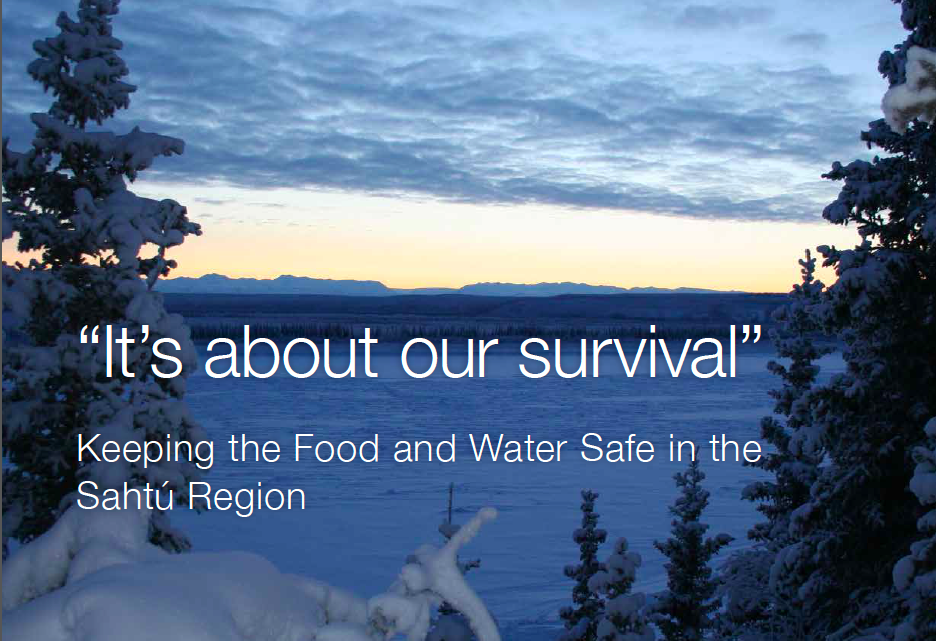
“It’s about our survival”: Keeping the Food and Water Safe in the Sahtú Region - Research Results Workshop, Tulít’a, November 27-28, 2013
From Report:
"People in the Sahtú Region are concerned that the health and safety of their food and water sources on the land could be threatened by contaminants, climate change, and cumulative impacts of industrial development. Sahtú communities have asked researchers to investigate and monitor the caribou, moose, fish, and water. Many of those research and monitoring projects have been ongoing for several years. Sahtú community members requested an update on the results of those projects so far, and an opportunity to give input on where the research should go next. It is important that community members are involved at every step of the way in research. The workshop report describes two examples of Sahtú communities being involved: monitoring of mercury levels in fish, and monitoring of caribou and moose health.
The good news is that researchers have found so far that, generally, the fish and wild game in the Sahtú Region are safe to eat and the water is safe to drink. Community members can feel confident that eating and drinking off the land is one of their best ways to stay healthy. It is up to community members, researchers, health officials, government agencies and co-management boards to work together to make sure things stay that way."
At the end of the report are 1- to 2-page summaries of research projects that have been going on in the Sahtú Region, with pictures and diagrams to help explain:
- Diversity of Sahba (Trout) in Great Bear Lake (Louise Chavarie)
- Long term monitoring of Great Bear Lake fisheries and the aquatic ecosystem (Kim Howland/ Deanna Leonard)
- Loche (burbot) contaminant research with Fort Good Hope (Gary Stern / Jesse Carrie)
- Watershed framework for assessing cumulative impacts of development (Krista Chin/ Julian Kanigan)
- Water quality monitoring on Mackenzie River (GNWT-ENR)
- Caribou genetics study (Jean Polfus)
- Sahtú wildlife health project (Susan Kutz / Anja Carlsson)
- Dene mapping project and wildlife study (Ɂehdzo Got’ı̨nę Gots’ę́ Nákedı)
Access this Resource:
Download the report PDF from the attachment field at the bottom of the page.
NWT ENR has also made this resource available on their website.
Morgan, Shauna and the Pembina Institute. “It’s about our survival”: Keeping the Food and Water Safe in the Sahtú Region - Research Results Workshop, Tulít’a, November 27-28, 2013. Tulı́t'a: Ɂehdzo Got’ı̨nę Gots’ę́ Nákedı (Sahtú Renewable Resources Board).
A View into the Sahtú: Land Claims and Resource Development
This thesis focuses on the Sahtú land claim process. It unpacks the impact of the agreement twenty years after its signing, the role that the land claim is playing in self-government negotiations, and its utility for managing natural resource development. Most of the field research informing this thesis was conducted in Norman Wells. Interviewees saw community-level resource management as less bureaucratic than larger regional (or Dene Nation-wide) organizational structures. However, overlapping jurisdictions in Tulı́t’a and K’asho Gotine are now making self-government negotiations more complicated.
Access this Resource:
Collections Canada has made this thesis available on their website.
When searching for the thesis, note that Sahtú is sometimes spelled Sahtu.
Smart, Miles. A View into the Sahtú: Land Claims and Resource Development. Master’s Thesis, Concordia University, 2014.
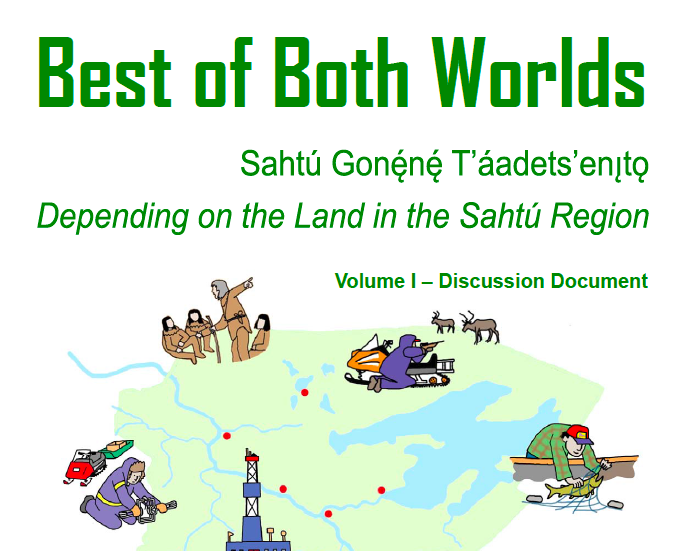
Best of Both Worlds: Sahtú Gonę̨̨́nę́ T’áadets’enıt̨ǫ – Depending on the Land in the Sahtú Region
Best of Both Worlds was a project sponsored by the SRRB that lead to the development of an action plan for a traditional economy in the Sahtú Region.
The Best of Both Worlds project is described in greater depth on its own section of the SRRB website, where the full PDF is also available.
Access this Resource:
Harnum, Betty, Joseph Hanlon, Tee Lim, Jane Modeste, Deborah Simmons, and Andrew Spring with The Pembina Institute. Best of Both Worlds: Sahtú Gonę́nę́ T’áadets’enı̨tǫ, Depending on the Land in the Sahtú Region. Tulıt’a: Ɂehdzo Got’ı̨nę Gots’ę́ Nákedı, Sahtú Renewable Resources Board, 2014.
Learning from the land: Indigenous land based pedagogy and decolonization
The authors introduce a special issue of Decolonization on the topic of land-based education. They frame the articles to follow with the premise that separating Indigenous peoples from land is a fundamental quality of colonization; and, as such, land-based education is an essential component of decolonization.
From Abstract:
This paper introduces the special issue of Decolonization on land-based education. We begin with the premise that, if colonization is fundamentally about dispossessing Indigenous peoples from land, decolonization must involve forms of education that reconnect Indigenous peoples to land and the social relations, knowledges and languages that arise from the land. An important aspect of each article is then highlighted, as we explore the complexities and nuances of Indigenous land-based education in different contexts, places and methods. We close with some reflections on issues that we believe deserve further attention and research in regards to land-based education, including gender, spirituality, intersectional decolonization approaches, and sources of funding for land-based education initiatives.
Access this Article:
The full PDF of this article is available from Decolonization online.
Wildcat, Matthew, Mandee McDonald, Stephanie Irlbacher-Fox, and Glen Coulthard. “Learning from the land: Indigenous land based pedagogy and decolonization.” Decolonization: Indigeneity, Education & Society 3, no. 3 (2014): I-XV.
Dechinta Bush University: Mobilizing a knowledge economy of reciprocity, resurgence and decolonization
Ballantyne uses Dechinta, 'Bush University,’ as an example of a decolonizing space, and comments on the responsibilities of settlers interested in decolonization theory. The author begins by addressing her own settler roots, then turning to the history of oil development in the Northwest Territories. She discusses the Berger inquiry, the land claim processes, and the diamond boom, and argues that the sense of inevitability with which resource exploitation is treated is counterintuitive to decolonizing efforts. Inevitability is inculcated in the early space of youth education, and Ballantyne reflects on experiences working in Fort Good Hope that helped her realize that a contextualized, land-based, collaboration-based pedagogy could be far more transformative for youth than classroom-based education.
From Abstract:
This article explores Dechinta Bush University as an Indigenous place-based movement that contributes to personal and collective transformation through mobilizing land-based knowledge and learning within a comprehensive strategy of resistance to settler capital. Through the production of a knowledge economy intervention, the pedagogical and political strategies of Dechinta are explored as a proven example of multi-scalar transformational decolonization that has far-reaching personal, collective, institutional, political and economic impacts. Through a detailed exploration of the five-year process of collective imagining, mobilizing and operating Dechinta Bush University, this article gives critical insights into closing the gap between the call for mass-scale decolonization and the dismantling of settler capitalism by exploring pathways which orient the land and Indigenous knowledge as relationships and core values mobilized towards a resurgence reality. Dechinta is herein conceived as a pathway movement of arming oneself with knowledge to fight the hierarchical scales of settler politics, a movement where collective and personal transformation through learning on the land is part and parcel of a strategy of resistance to settler capital, producing an alternative knowledge economy centered around the value of land as an infinite producer of health, knowledge, and sustainable, self-determining communities.
Read more about Dechinta on this database, or consult its website.
Access this Resource:
Read the full PDF on Decolonization online.
Ballantyne, Erin Freeland. “Dechinta Bush University: Mobilizing a knowledge economy of reciprocity, resurgence and decolonization.” Decolonization: Indigeneity, Education & Society 3, no. 3 (2014): 67-85.
 Phone: 867-374-4041
 Email: