
A Journey Toward Inter-cultural Awareness
This paper focuses on the importance of inter-cultural awareness in northern teachers. The authors discuss Dene Kede curriculum as an educational tool that contextualizes the NWT’s K-6 curriculum classes (English Language Arts, Math, Science, etc.) with a focus on the self and its fundamental relationships. Learning the Dene way is experiential and connected with the land, and understanding/implementing this is often a challenge for new teachers from the south.
Grieg and Norwegian present Dene Kede: Trails to Becoming, an interactive CD-ROM game intended to help teachers learn about traditional Dene culture and ways to integrate Dene Kede curriculum into their classes. They are introduced to the Dene Kede educational model, and they are also encouraged to identify their own world views and biases in a set of exercises. The authors suggest that one weakness of this approach is the absence of shared learner outcomes and feedback.
Abstract:
The purpose of the Dene Kede: Trails to Becoming is to introduce teachers new to the Northwest Territories to the Dene, who are members of Canada's First Nations. Through a CD-ROM they will embark on a journey of discovery toward intercultural awareness and sensitivity. They will learn about the traditional Dene culture within the context of the Dene ways of knowing and will explore ways of integrating Dene Kede into their classroom lessons. The Dene Kede curriculum represents a very important step in the evolution of integrating the Dene culture into the classrooms of the Northwest Territories.
Access this Resource:
This conference paper is not available open access, but can be purchased from the Learning and Technology Library.
Grieg, Debra, and Gladys Norwegian. “A Journey Toward Inter-cultural Awareness.” Chesapeake: World Conference on Educational Media and Technology, 2010.
Final Report on the Review of the Official Languages Act 2008-2009, Reality Check: Securing a Future for the Official Languages of the Northwest Territories
The Standing Committee on Government Operations evaluated the Official Languages Act. The Committee encountered a number of key concerns during the hearings they held for this review. The lack of an implementation plan for the OLA, along with an absence of regulations, meant that standards for OL services were inconsistent and inaccessible to the public. Aboriginal languages speakers identified inequalities in support for French and their own languages, and a lack of communication between Aboriginal language communities and the NWT. The Aboriginal Languages Board did not succeed in bridging this gap.
Other challenges identified included:
- A lack of Interpreter/Translators in the health and justice systems, need for increased terminology development
- A lack of accountability for Government commitments
- A widening intergenerational communication gap
- Under resourced Aboriginal languages curriculum development
- Insufficient languages instruction, insufficient funding, resources, and training for instructors
- Funding for community languages programs is inconsistent, minimal, and causes interruptions in programs, prevents expansion, does not consider needs fairly, does not allow for year-round programming, and is inaccessible (information is difficult to find).
The committee also named some improvements, mostly stemming from the department of Education, Culture, and Employment:
- language nest program introduction
- Dene Kede curriculum implementation
- progresses in teacher training
One section of the report describes a meeting with Sahtú community members in Délı̨nę, 2008. Representatives emphasized on the land language and culture communication, and called for compulsory Aboriginal language instruction. They also commented that Dene Kede curriculum should be supported by Divisional Education Councils, and that school staff needed more support and training to use the curriculum properly. They also identified the challenge of having many fluent speakers without teaching certification, and the challenge of certified Dene teachers using English as a primary language. They called for more funding, more community involvement, and they did not know who the Languages Commissioner was or what their mandate and activities might be. They also requested more access to Interpreter/Translators (and training for them) particularly in the Justice system. (61-63)
In addition, the report contains some comments on Dene Kede curriculum from various study participants, replicated here.
- Tłįchǫ̨ delegates say their Language Centre really helped with implementing Dene Kede curriculum. They developed cultural resource kits, worked with teachers, developed teaching materials for different units, and run a one-week on-the-land orientation for new teachers. (55)
- Sahtú Delegates: Dene Kede needs more support from DECs.
- Summary (all): Lack of resources, supporting materials for Dene Kede implementation (75)
Access this Resource:
The Legislative Assembly of the Northwest Territories has made this resource available on their website.
Standing Committee on Government Operations, Legislative Assembly of the Northwest Territories. Final Report on the Review of the Official Languages Act 2008-2009, Reality Check: Securing a Future for the Official Languages of the Northwest Territories. Committee Report 6-16(3), Tabled May 28, 2009.
Annual Report on Official Languages 2008-2009
Every fiscal year, the Government of the Northwest Territories issues a record of measures taken to implement the Official Languages Act. Each report details developments in both French and Aboriginal language programming. Many programs focus on connecting youth with elders, training teachers, developing curriculum, and providing government services in as many languages as possible.
Access this Resource:
The Government of the Northwest Territories makes reports from the last decade available here: https://www.ece.gov.nt.ca/en/services/francophone-affairs-secretariat/official-languages-annual-reports
Government of the Northwest Territories. Annual Report on Official Languages. Yellowknife: 2009.
Engaging and empowering Aboriginal youth: A toolkit for service providers
This document presents a number of tools for adapting youth-focused programs to meet the needs of young Aboriginal people. They advocate for a strengths-based approach, which means focusing on factors that protect Aboriginal youth from violence, suicide, substance abuse, etc., rather than giving too much attention to negative statistics. Their approach also emphasizes understanding and integrating cultural identity, and they offer a self-assessment guide, specific strategies, ideas about working with schools, and research considerations.
From Abstract:
From coast to coast to coast in Canada, there is growing recognition that many youth programs do not adequately meet the needs of Aboriginal youth. Some programs have been developed without any thought to the unique circumstances of Aboriginal youth. Others have been superficially adapted with respect to program materials, but without a deeper consideration of the myriad programmatic, organizational, and evaluation factors that require fine tuning. Many program staff and community leaders are eager for guidance to more meaningfully adapt or develop programs that meet the needs of these youth.
This toolkit is our attempt to provide such a guide for front-line service providers, facilitators, educators, community partners, and researchers. We hope that individuals from all these groups will find something in this manual to help them improve their work with Aboriginal youth.
Access this Resource:
Strategies for Healthy Youth Relationships has made this resource available for free on their website: https://youthrelationships.org/engaging-aboriginal-youth-toolkit
Crooks, Claire, Debbie Chiodo, Darren Thomas, Shanna Burns, and Charlene Camillo. Engaging and Empowering Aboriginal Youth: A Toolkit for Service Providers, 2nd edition. Victoria: Trafford Publishing, 2010.
Tracks that matter: On space, place and Hare Indian ethnobiology with special reference to the Marten (Martes americana)
Abstract:
The empirical setting and context for this contribution is the Hare Indian land in the Northwest Territories in Canada. The author opposes a purely taxonomic approach to ethnobiology. The main focus is on the Hare Indian trappers’ knowledge about prey animals, most notably the marten. This knowledge is based on experiences involving both practical and emotional engagement as well as narrative communication. It is argued that this knowledge is converted to actual trapping strategies. The same knowledge also has implications for identity management, because it is regarded as a prerequisite in order to feel at home in a Hare Indian Space, and it is also linked to how places are invested with emotion. Thus the trappers’ behavior and action is not only invested with, but also motivated by, emotion. Based on empirical information, it is suggested that feelings about the nature of nature and what it contains are generated by how associations are tied to clusters of significant observations and ideas.
Access this Resource:
DOI: https://doi.org/10.1080/08003830902951540
Broch, Harald. "Tracks that Matter: On Space, Place and Hare Indian Ethnobiology with special reference to the Marten." Acta Borealia 26, no. 1 (2009): 77-95.
A Fine Balance? Aboriginal Peoples in the Canadian North and the Dilemma of Development
Slowey identifies a rhetorical trend that frames the choice between development and land claims as a choice between “capitalism or traditionalism, assimilation or fossilization (2009: 229). This false binary is antithetical to self-determination, which often requires both economic development and cultural preservation as joint efforts (gas for snowmobiles, for example). Slowey further suggests that informal connections in a community are effective mechanisms of creating pragmatic self-governance, while formal agreements are capitulations that normalize “the existing the relations of the state” (Slowey 2009: 236). Nonetheless, self-government is one step towards detachment, if not decolonization, and may be the best possible scenario until Aboriginal communities can grow autonomously.
Access this Resource:
Read Chapter 9 in the Google Book Preview below or on Google Books.
Slowey, Gabrielle. “A Fine Balance? Aboriginal Peoples in the Canadian North and the Dilemma of Development.” In First Nations, First Thoughts: The Impact of Indigenous Thought in Canada, edited by Annis May Timpson, 229-243. Vancouver: UBC Press, 2009.
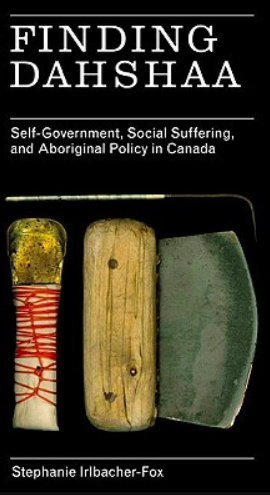
Finding Dahshaa: Self-Government, Social Suffering, and Aboriginal Policy in Canada
Irlbacher-Fox presents her experience with self-government negotiations in the Sahtu. She proposes the existence of a 'dysfunction theodicy,’ within which a colonial state frames a colonized community as suffering, and “shifts responsibility for suffering onto the sufferers, establishing itself through discourse and action as a necessary and legitimate interventionist agent in the lives of Indigenous people alleged to lack the capacity to recognize or alter what the state alleges to be their own suffering-inflicted actions” (107). For example, state intervention in childcare, 'substandard education,’ or 'corrupt local government’ are all manifestations of a dysfunction theodicy.
Abstract:
Just as dahshaa - a rare type of dried, rotted spruce wood - is essential to the Dene moosehide-tanning process, self-determination and the alleviation of social suffering are necessary to Indigenous survival in the Northwest Territories. But is self-government an effective path to self-determination? Finding Dahshaa shows where self-government negotiations between Canada and the Dehcho, Deline, and Inuvialuit and Gwich'in peoples have gone wrong and offers, through descriptions of tanning practices that embody principles and values central to self-determination, an alternative model for negotiations. This accessible book, which includes a foreword by Dene National Chief Bill Erasmus, is the first ethnographic study of self-government negotiations in Canada.
Access this Resource:
Read the Google Books page
Borrow the full text from your local or institutional library
Irlbacher-Fox, Stephanie. Finding Dahshaa: Self-Government, Social Suffering, and Aboriginal Policy in Canada. Vancouver: UBC Press, 2009.
Annual Report on Official Languages 2007-2008
Every fiscal year, the Government of the Northwest Territories issues a record of measures taken to implement the Official Languages Act. Each report details developments in both French and Aboriginal language programming. Many programs focus on connecting youth with elders, training teachers, developing curriculum, and providing government services in as many languages as possible.
Access this Resource:
The Government of the Northwest Territories makes reports from the last decade available here: https://www.ece.gov.nt.ca/en/services/francophone-affairs-secretariat/official-languages-annual-reports
Government of the Northwest Territories. Annual Report on Official Languages. Yellowknife: 2008.
Aboriginal participation, consultation, and Canada's Mackenzie gas project
This paper provides an overview of the oil and gas industry’s interest in Arctic and Subarctic regions, and the negotiations between industry, governments, the market, and Indigenous peoples. Many communities face pressure to support development projects. Northern Canada’s Mackenzie Gas Project is the focus of this article, and its interactions with Indigenous peoples in the Mackenzie region. The paper examines both local and industry perspectives, including Indigenous concerns over participation and consultation.
From Abstract:
For the oil and gas industry, Arctic and Subarctic regions are considered to be some of the world's last energy frontiers, increasingly important for meeting global energy demands. As exploration intensifies and oil and gas development occurs in more of the Arctic, indigenous peoples are increasingly concerned about the interest of industry, national governments, and the far-reaching impact of the world market in their homelands. Pressure to sign on to development projects, to communicate and negotiate with industry and governments, and to adapt to a changing environment resulting from the activities of extractive industries is increasing. As a result, some indigenous peoples feel that they are losing control over their homelands and over their livelihoods. This article examines northern Canada's Mackenzie Gas Project and its possible implications for Aboriginal peoples in the Northwest Territories and northern Alberta. The Mackenzie Gas Project would see the development on Aboriginal lands of natural gas from three fields in the Mackenzie Delta area for delivery to markets in Canada and the United States by a pipeline up the Mackenzie Valley. The article looks at some of the key issues of this controversial project, examines local concerns over participation and consultation, and shows how it provides insight into some of the contested perspectives on the future of northern Canada, its peoples and the environment.
Abstract:
The full text of this article is hosted on Energy and Environment and EconPapers, but is not currently open access.
Nuttall, Mark. “Aboriginal participation, consultation, and Canada’s Mackenzie Gas Project.” Energy & Environment 19, no. 5 (2008): 617-634.
Cultural Continuity as a Protective Factor against Suicide in First Nations Youth
The authors address the topic of young Indigenous suicide as receiving increased attention following reports like the Royal Commission on Aboriginal Peoples. Following earlier research (Chandler and Lalonde 1998), the authors take a second time period of data (1993-2000) from Indigenous communities in British Columbia and replicate their original findings. They contend again that cultural continuity, as measured by community activities, lowers a community’s suicide rate. In addition, they add two new components of cultural continuity: local control of child welfare services, and band councils composed of more than 50 percent women.
Abstract:
This research report examines self-continuity and its role as a protective factor against suicide. First, we review the notions of personal and cultural continuity and their relevance to understanding suicide among First Nations youth. The central theoretical idea developed here is that, because it is constitutive of what it means to have or be a self to somehow count oneself as continuous in time, anyone whose identity is undermined by radical personal and cultural change is put at special risk of suicide for the reason that they lose those future commitments that are necessary to guarantee appropriate care and concern for their own well-being. It is for just such reasons that adolescents and young adults - who are living through moments of especially dramatic change - constitute such a high-risk group. This generalized period of increased risk during adolescence can be made even more acute within communities that lack a concomitant sense of cultural continuity which might otherwise support the efforts of young persons to develop more adequate self-continuity-warranting practices. We present data to demonstrate that, while certain indigenous or First Nations groups do in fact suffer dramatically elevated suicide rates, such rates vary widely across British Columbia's nearly 200 aboriginal groups: some communities show rates 800 times the national average, while in others suicide is essentially unknown. Finally, we demonstrate that these variable incidence rates are strongly associated with the degree to which British Columbia's 196 bands are engaged in community practices that are employed as markers of a collective effort to rehabilitate and vouchsafe the cultural continuity of these groups. Communities that have taken active steps to preserve and rehabilitate their own cultures are shown to be those in which youth suicide rates are dramatically lower.
Access this Resource:
The full text of this report is available on ResearchGate and Sage Journals.
Chandler, Michael J., and Christopher Lalonde. “Cultural Continuity as a Protective Factor against Suicide in First Nations Youth.” Horizons—A Special Issue on Aboriginal Youth, Hope or Heartbreak: Aboriginal Youth and Canada’s Future no. 10 (2008): 68–72.
 Phone: 867-374-4041
 Email: