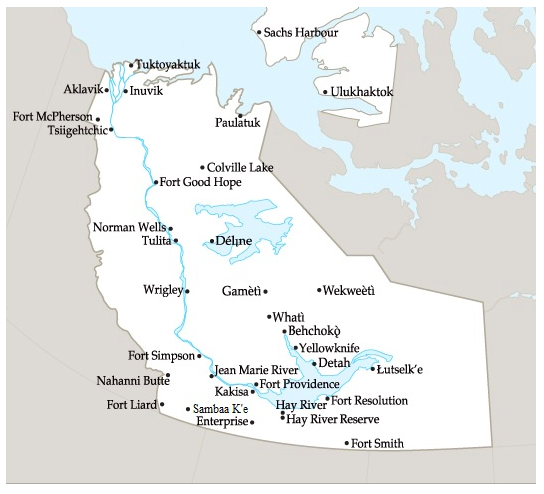
Ɂehdzo Got’ı̨nę Gots’ę́ Nákedı
Sahtú Renewable Resources Board

Catalogue

This document is one of six appendices from the first iteration of the report From Dene Kedǝ to Dene Ts’ı̨lı̨: Rethinking Resurgence in the Sahtú RegionIn it, the team provides a basic historical review of some of the data collected about Dene language speakers and learners in the Sahtú, along with figures on land use, subsistence, and arts. It also includes some qualitative data about Sahtú perceptions or ideologies of language and revitalization. 

About the project: 

From Dene Kedǝ to Dene Ts’ı̨lı̨ is a collaborative project that explores lessons learned through the past fifty years of Dene and Métis language and way of life initiatives. Bringing together knowledge and experience from longtime activists and educators and youth, as well as review of over 275 documents, the aim is to create a resource for decision-makers and researchers as a basis for resurgence in the Sahtú Region. All phases of this project involve a dialogue between today’s initiatives and yesterday’s legacy.

The picture that has emerged is complex, involving at least seven domains of resurgence: speakers and learners; local knowledge; documentation; education; media; law and policy; and ways of life. During this project we saw the emergence of exciting projects like the Dene Ts’ı̨lı̨ School, a cross-cultural on the land learning opportunity for youth. This school became an integral part of the research and learning process.

Read more about From Dene Kedǝ to Dene Ts’ı̨lı̨Download the appendix using the PDF link at the bottom of this page. 

Cite this resource:

"Appendix D - Speakers and Learners–Data Collection on Language, Practice, and Ideology in the Sahtú" in Faun Rice, Keren Rice, Deborah Simmons, Walter Bezha, Jordan Lennie, Shelby Lennie, Michael Neyelle. From Dene Kedǝ to Dene Ts’ı̨ lı̨: Rethinking Resurgence in the Sahtú Region, Northwest Territories©Ɂehdzo Got’ı̨ nę Gots’é ̨ Nákedı (Sahtú Renewable Resources Board), Tulı́ t'a, Northwest Territories, www.srrb.nt.ca. October 2017 Edition.

This document is one of six appendices from the first iteration of the report From Dene Kedǝ to Dene Ts’ı̨lı̨: Rethinking Resurgence in the Sahtú RegionIn it, the team provides a timeline of selected events and projects throughout Sahtú history, contextualized by events in the Northwest Territories and in Canada. 

About the project: 

From Dene Kedǝ to Dene Ts’ı̨lı̨ is a collaborative project that explores lessons learned through the past fifty years of Dene and Métis language and way of life initiatives. Bringing together knowledge and experience from longtime activists and educators and youth, as well as review of over 275 documents, the aim is to create a resource for decision-makers and researchers as a basis for resurgence in the Sahtú Region. All phases of this project involve a dialogue between today’s initiatives and yesterday’s legacy.

The picture that has emerged is complex, involving at least seven domains of resurgence: speakers and learners; local knowledge; documentation; education; media; law and policy; and ways of life. During this project we saw the emergence of exciting projects like the Dene Ts’ı̨lı̨ School, a cross-cultural on the land learning opportunity for youth. This school became an integral part of the research and learning process.

Read more about From Dene Kedǝ to Dene Ts’ı̨lı̨Download the appendix using the PDF link at the bottom of this page. 

Cite this resource:

"Appendix E - Timeline of Dene Kedǝ and Dene Ts’ı̨lı̨ Events" in Faun Rice, Keren Rice, Deborah Simmons, Walter Bezha, Jordan Lennie, Shelby Lennie, Michael Neyelle. From Dene Kedǝ to Dene Ts’ı̨ lı̨: Rethinking Resurgence in the Sahtú Region, Northwest Territories©Ɂehdzo Got’ı̨ nę Gots’é ̨ Nákedı (Sahtú Renewable Resources Board), Tulı́ t'a, Northwest Territories, www.srrb.nt.ca. October 2017 Edition.

Last modified on Tuesday, 03 July 2018 18:40

This document is one of six appendices from the first iteration of the report From Dene Kedǝ to Dene Ts’ı̨lı̨: Rethinking Resurgence in the Sahtú RegionIn it, Sahtú Dene and Métis co-authors reflect on their lived experiences and share stories that provide important human context for the history outlined in the report. 

About the project: 

From Dene Kedǝ to Dene Ts’ı̨lı̨ is a collaborative project that explores lessons learned through the past fifty years of Dene and Métis language and way of life initiatives. Bringing together knowledge and experience from longtime activists and educators and youth, as well as review of over 275 documents, the aim is to create a resource for decision-makers and researchers as a basis for resurgence in the Sahtú Region. All phases of this project involve a dialogue between today’s initiatives and yesterday’s legacy.

The picture that has emerged is complex, involving at least seven domains of resurgence: speakers and learners; local knowledge; documentation; education; media; law and policy; and ways of life. During this project we saw the emergence of exciting projects like the Dene Ts’ı̨lı̨ School, a cross-cultural on the land learning opportunity for youth. This school became an integral part of the research and learning process.

Read more about From Dene Kedǝ to Dene Ts’ı̨lı̨Download the appendix using the PDF link at the bottom of this page. 

Cite this resource:

"Appendix B - Co-Author Reflections" in Faun Rice, Keren Rice, Deborah Simmons, Walter Bezha, Jordan Lennie, Shelby Lennie, Michael Neyelle. From Dene Kedǝ to Dene Ts’ı̨ lı̨: Rethinking Resurgence in the Sahtú Region, Northwest Territories ©Ɂehdzo Got’ı̨ nę Gots’é ̨ Nákedı (Sahtú Renewable Resources Board), Tulı́ t'a, Northwest Territories, www.srrb.nt.ca. October 2017 Edition.

Last modified on Tuesday, 03 July 2018 18:41
Wednesday, 13 June 2018 00:03

Community Data: NWT Bureau of Statistics

The NWT Bureau of Statistics provides community profiles for all NWT communities. Read about language use, harvesting and arts data, housing and employment, and other items. 

Some of the most consistent, publicly available, methodically gathered statistics on language use in the Sahtú come out of the GNWT Bureau of Statistics community surveys. The community surveys are done every 2 or 3 years, in between census cycles, and the questions on them have remained constant so as to be comparable throughout time. Only two questions have been added or changed since the first survey (one on berry harvesting, one on arts and crafts). Workers conduct person-to-person interviews in all official languages, done in winter months so that people will be home instead of on the land.

Screen Shot 2018-06-13 at 5.03.13 AM.png

Access this resource:

Visit the NWT Bureau of Statistics Website and select any community to view a statistical profile. https://www.statsnwt.ca/community-data/

Last modified on Wednesday, 13 June 2018 00:18
Wednesday, 06 June 2018 21:26

The Inquiry Film

From Description: "The Inquiry Film was shot in the summer of 1976, during the final months of the Berger Inquiry. It features interviews with many key figures in the Inquiry, as well as footage from the community hearings at Rae (Behchokǫ̀) and Colville Lake. This independent film, produced by Arthur Pape and directed by Jesse Nishihata, won the Canadian Film Festival Award for Best Documentary over 90 Minutes in 1977. The film was donated to the Prince of Wales Heritage Centre by Michael Jackson, Special Counsel for the Berger Inquiry."

Read more about the Inquiry in the Final Report: Northern Frontier, Northern Homeland. 

Watch the film on Vimeo or the Prince of Wales Northern Heritage Centre website. 

Access this Resource: 

Nishihata, Jesse. The Inquiry Film. Toronto : CFMDC, 1977.


Last modified on Tuesday, 03 July 2018 18:56

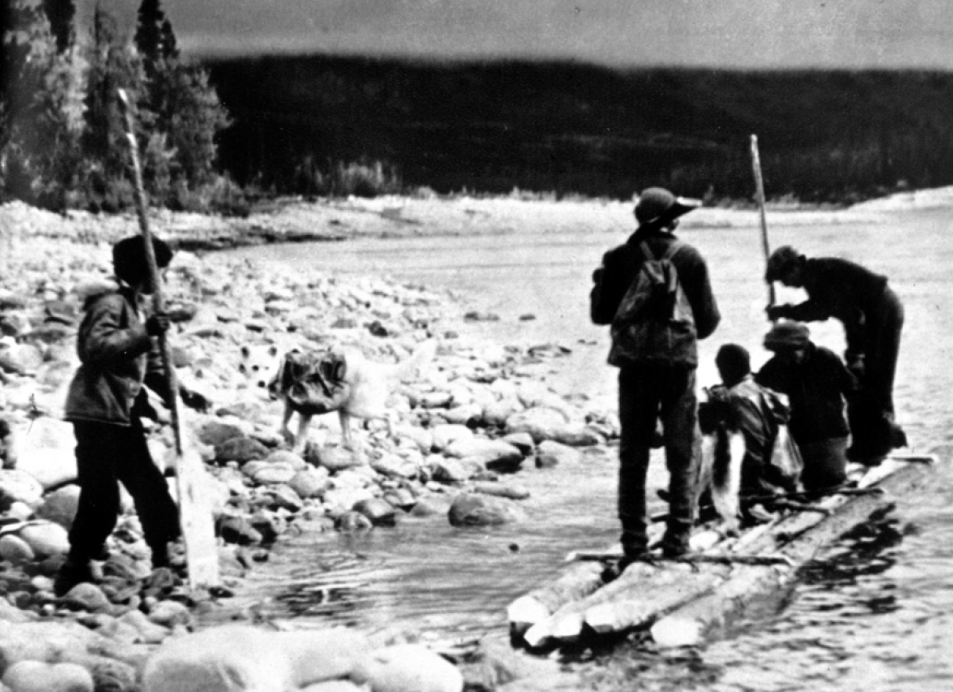
Jean Michéa was a French anthropologist doing fieldwork in Fort Norman and the surrounding region during 1957-1958. He writes about his experiences both in what is now Tulı́t’a, and with the mountain Dene whom he spent some time with. His work talks about social organization, daily life, boat-making, and other aspects of nomadic ways of life. 

Read the CBC Article about the film Michéa shot in Tulı́t’a, and the process of recovering it and archiving it in the community: "18-year quest brings 1957 film home to N.W.T. Dene" (2014)

Screen Shot 2018 05 01 at 12.02.39 AM     Screen Shot 2018 06 07 at 1.49.57 AM

Photograph courtesy of Tom Andrews via CBC News. 

Access this resource:

Full text available at: http://www.persee.fr/doc/jsa_0037-9174_1959_num_48_1_1192

Michéa Jean. “Les Chitra-Gottinéké, groupe Athapascan des Montagnes Rocheuses.” Journal de la Société des Américanistes 48 (1959): 197-235. 

Last modified on Wednesday, 06 June 2018 20:58
Saturday, 13 January 2018 11:00

Native Broadcasting in Canada

This paper discusses the early years of radio in Northern Canada, including both “trail radio,” (i.e., hand-held, then two-way communications for bush travel). “Community radio,” as opposed to trail radio, was a CBC service provided to all Canadian communities of 500 or more, requiring only a small transmitter, reasonable premises, and a local radio society of volunteers. The paper explains that local operators could decide which CBC radio programs would be aired: including the Dene languages programming produced in Yellowknife. Many local stations created “phone-in” time, and the author gives one example of a station in Povungnituk which played a traditional game where one player imitates an animal on air, and the first caller to correctly identify the animal wins. The author emphasizes radio’s role in language preservation, but also in building strong community relationships. The report ends by heralding the beginning of the Northern Native Broadcast Access Program (NNBAP), and commenting that it may be useful in combatting the increase in southern television programming on northern screens.

Abstract: This article examines recent efforts to create native radio and television stations in Canada. In the beginning, trail and community radio provided the initial model for native Canadian broadcasting. Eventually, the Northern Native Broadcast Access Program, sponsored by the Native Citizens Directorate of the Secretary of State, led to further developments. In the last few years, native Canadian broadcasters have created many innovations and have successfully confronted the challenge of presenting serious discussions of native issues to a native audience which was previously accustomed to commercial, light-entertainment programing from southern Canada and the United States.

Read more about the history of northern broadcasting on this database: from APTN, and from The Northern Review. 

Read the SRRB Facebook feature on this topic from March 2018. 
Access this Resource: 

Research Gate

JSTOR

Rupert, Robert. "Northern Broadcasting in Canada." Anthropologica 25, no. 1 (1983): 53-61.

Last modified on Wednesday, 06 June 2018 21:12

This paper goes over an interview with Matha Johnson, then Research Director of the Dene Cultural Institute (DCI). The conversation touches upon TEK in schools, challenges and opportunities faced by the DCI in its early years, and the future of TEK in resource management.

Screen Shot 2018 05 01 at 12.15.12 AM


From Introduction: 

"Western science’s failure to recognize traditional environmental knowledge (TEK) was first made obvious to Martha Johnson more than ten years ago when she was working as a high school teacher in Povungnituk, an Inuit community in northern Quebec. She remembered realizing that “as a non-Aboriginal trying to teach science from a Western perspective, it wasn’t working. So I asked myself, “How do the Inuit perceive the environment?” Johnson began experimenting in learning techniques to find ways of tapping the knowledge passed down among the Inuit. In one exercise, she gave students a diagram of the Arctic food chain and asked them to make the links. One practically illiterate boy made the connections without any problems. Later, Johnson pursued a Master’s degree in Environmental Studies and Anthropology at the University of Toronto. Her major paper examined Inuit folk ornithology, comparing Inuit classification of birds to Western groupings. Johnson’s grassroots experience with Aboriginal communities and her formal studies helped her recognize the holistic nature of TEK. “It combines biology, linguistics, social sciences, and other disciplines and connects them in an interdisciplinary way to examine how people perceive their world, live within it and use its resources” she comments. Johnson spoke about traditional environmental knowledge, the reasons behind its growing recognition, and current research in this field during an interview in Ottawa early this year. She is now Research Director of the Dene Cultural Institute in Canada’s Northwest Territories. The Institute works with Dene communities to preserve and promote this Canadian aboriginal group’s culture, through research and education. Much of the Institute’s work has focused on TEK through research and the publication of a book entitled Lore: Capturing Traditional Environmental Knowledge, edited by Johnson. The book was based on papers produced from a 1990 workshop on TEK, organized by the Dene Cultural Institute. IDRC funded the workshop as a cultural exchange between researchers in developing countries and those working in Canadian aboriginal communities. Community-based projects on TEK in the Amazon Rainforest, the African Sahel, the South Pacific and Southeast Asia were represented at the workshop. The Institute also invited aboriginal community members and researchers from northern Canada’s Belcher Islands. Workshop participants discussed the problems of gathering TEK and integrating it with Western Science to improve natural resource management. They also experienced Dene culture through food, music and dance. The participants’ papers, outlining their project’s research methodology, were incorporated in Lore."

Access this Resource:

The full text of this paper is available from the Community Development Library

Carter, Deborah. “Recognizing Traditional Environmental Knowledge.” Ottawa: International Development Research Centre Reports 21, no. 1 (1993).

Last modified on Wednesday, 06 June 2018 21:15
Saturday, 13 January 2018 11:00

The Mackenzie Valley Pipeline Inquiry

In a retrospective piece, Justice Berger looks back at his reasons for recommending a 10-year postponement of the Mackenzie Valley Pipeline, along with his recommendations to create several wildlife sanctuaries in the Yukon and Northwest Territories. Contextualized by the time of writing, he comments that neither capitalist nor communist economic systems were equipped or prepared to recognize that sustainable growth and industrialization were not actually sustainable. He makes a case for recognizing finite natural resources and spaces, and considering ecology and diversity as a part of any planning process.

Screen Shot 2018 05 01 at 12.22.15 AM


Berger's impact on northern resource development and the legal legacy of the Mackenzie Valley Pipeline Inquiry has been remembered by many. Read about Berger's current activities in the CBC article: "B.C. makes symbolic choice in retaining Thomas Berger as counsel in Trans Mountain challenge." 

Watch The Inquiry Film, hosted by the Prince of Wales Northern Heritage Centre. 

Access this Resource:

Berger, Thomas R. “The Mackenzie Valley Pipeline Inquiry.Osgood Hall Law Journal 16 (1978): 639-647.


Last modified on Wednesday, 06 June 2018 21:26

The authors discuss a 1985 Southern Tutchone radio broadcast wherein co-performers used deitic spatial terms, placing a listener in relationship to the landscape being discussed, and “spatially evoking the history of the entire region.” (282). The authors contend that the linguistic features of radio performances such as these are linked to social uses and perceptions of place, including land claims and Indigenous rights to land.

Screen Shot 2018 05 01 at 12.33.41 AM

Access this Resource: 

Moore, Patrick and Daniel Tlen. “Indigenous Linguistics and Land Claims: The Semiotic Projection of Athabaskan Directionals in Elijah Smith's Radio Work.” Journal of Linguistic Anthropology 17, no. 2 (December 2007): 266-286.


Last modified on Monday, 30 April 2018 19:36