
Higher Education in the Northwest Territories.
Hilyer’s chapter provides a historical overview of higher education in the Northwest Territories, along with some of the challenges to early institutions. The text outlines the history of the Adult Vocational Training Centre, Thebacha College, and Arctic College. In a 1992 survey of Arctic College students, 58% of students were women, 14% of students brought their children to campus, 75% were of Aboriginal origin, and they came from 58 different communities in the territories. For first languages, 65% had English, 8.5% Inuktitut and 2% North Slavey and Dogrib.
Read more about the history of education and curriculum development in the Northwest Territories.
Access this Resource:
Hilyer, Gail M. “Higher Education in the Northwest Territories.” Higher Education in Canada: Different Systems, Different Perspectives, edited by Glen A. Jones, 301-323. New York: Garland Publishers, 1997.
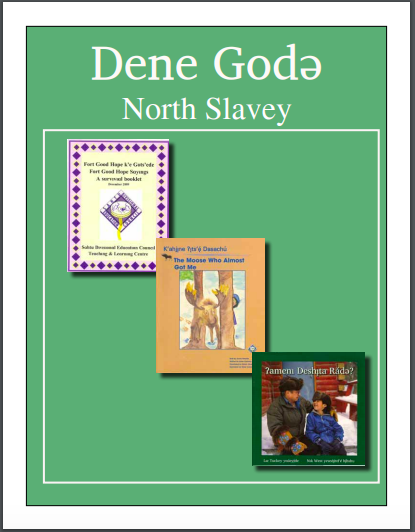
Dene Godǝ - North Slavey Bibliography
This 20 page bibliography provides publication information, summaries, keywords, and images of book covers for Dene Kedǝ language and literacy resources. It appears to be organized very loosely by date of publication, ranging between 1979 and 2007. Original sources for a number of publications in the 1980s were the Black Lake First Nations, adapted for the Sahtu. A trend of the time to save on cost and effort was to use templates from other areas to develop materials.
Read more about Dene language learning resources by selecting the tags "language" or "education" on the left hand menu.
Access this Resource:
This resource is attached as a PDF below, and is also available on the SSDEC website.
Sahtú Divisional Education Council. Dene Godǝ - North Slavey Bibliography. Norman Wells: Sahtu Divisional Education Council, n.d.
How to Get it Across: some ideas for integrating local content in the school curriculum.
The research team currently has no hard information about the date and origins of this document, but it is with a collection of items from the early 1980s pertaining to curriculum development in the Sahtú region by Cynthia Chambers and others with the Linguistic Programs Division of the NWT. The document makes reference to NWT local education authorities and is NWT-specific.
This 7 page document seems to be a guide for local curriculum supporting teachers to build specific content to fit into the core curriculum for their classes. It recommends a close assessment of audience (e.g. age, reading level), resources, and distribution. It makes suggestions for reaching young children: such as keeping to “practical, hands-on and real experiences” until the ages of 10-12 when abstract history and cultural heritage can be related (3). Interestingly, it comments that time references like “long ago,” or “before there were white people here” will allow children to place these histories in the same category as fairy tales and myths. Conversely, situating history with respect to a child’s grandmother, or showing a picture, will help them relate more directly to the content.
Read more about the history of the inclusion of local knowledge in formal curriculum in the Northwest Territories.
Access this Resource:
“How to get it across: Some ideas for integrating local content in the school curriculum.” NWT Archives, Northwest Territories, n.d. Accession no. N-2007-014.
This item is not listed in the NWT archives item search, but was found by one of our researchers in the Cynthia Chambers Collection.
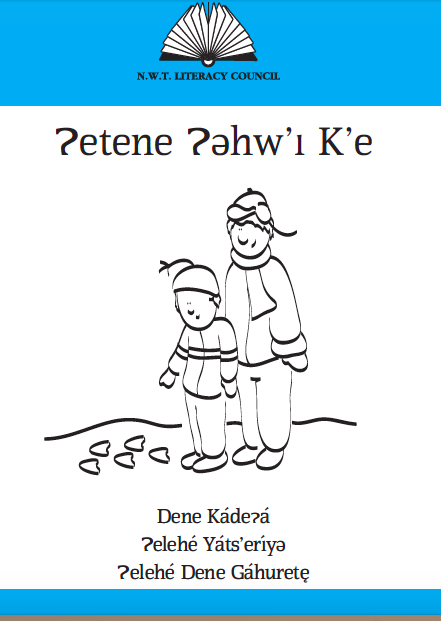
Ɂetene Ɂǝhw’ı K’e – Dene Kádeɂá, Ɂelehé Yáts’erı́yǝ, Ɂelehé Dene Gáhuretę (On the Right Track)
This is a monolingual booklet about family activities. It may be a translation of a Saskatchewan Literary Network family literacy resource, adjusted by the NWT literacy council for northern languages. There is a foreword, where the text begins:
Menı gots’éráyı̨́dı máhsı héts’ǝdı. Hǝderı ɂedı̨htl’é ɂeyı Saskatchewan gots’ę ɂedı́tl’e hots’edúhsha gáɂeghálayeda keyá kıdeyı̨́tl’e. Wáyı júhad́ néné gogha ɂawót’e gha júhad́ ɂedı́tl’e gha dǝhw’ı ke rakıdeyı̨́tl’é. Júhad́ ɂedı́tl’é gha dǝ́hw’ı ke March 2002 gú ɂeyı júhad́ Government ɂeyı tsǫ́dane hı̨́delé gáhurútǝ̨́ gá ɂeghalayeda ke sǫ́ba hé gots’érákeyı̨́dǝ gháré hǝdǝrı ɂedı̨htl’é kedeyı̨́tl’e.
Read more materials from the Northwest Territories Literacy Network: https://www.nwtliteracy.ca/resources/indigenous-languages-and-literacies
Access this Resource:
Northwest Territories Literacy Council, Saskatchewan Literacy Network. Translated by Lucy Ann Yakelaya. Ɂetene Ɂǝhw’ı K’e – Dene Kádeɂá, Ɂelehé Yáts’erı́yǝ, Ɂelehé Dene Gáhuretę (On the Right Track), n.d.
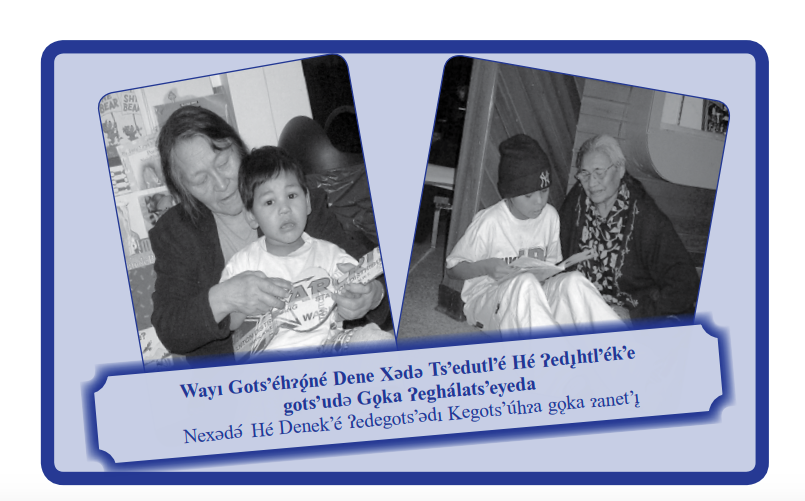
Building Aboriginal Literacy Cards
These are a series of monolingual cards with photographs from Sahtú communities and Dene words. The introduction reads,
Dene xǝdǝ la begháré dene ts’ı̨lı̨ gha ket’ódeɁá yá ɂagóht’e. Dene xed́é k’égháré yá dene he’egúɂa, denewá ts’ı̨lı̨́ k’égháré ɂadegots’ǝdı hé ts’ı̨duwe légots’ede gháré dúle hı̨dówé gots’é bet’óts’edéhɂa. Menı begǫhlı̨ gots’é dene xǝdé k’é bet’sé gots’ǝdǝ nı́dé ɂeyı keyá dzı’ıne toréht’é kedexǝdǝ́ k’é denets’é gokǝdǝ gha.
Ts’ǫ́dane ke kugólı̨ gots’ę kugháı́ sóɂareht’e gots’é dúle t’áhsı̨ gołǫ kegokı́hɂa yá ɂakı̨t’e. Ɂeyı gháré dene hı̨sha ke hé menıdene xǝdǝ́ k’égodǝ ke ts’ǫ́dane ke kedexǝdǝ́ kúshu gha le’rakede.
Read more materials from the Northwest Territories Literacy Council: https://www.nwtliteracy.ca/resources/indigenous-languages-and-literacies
Access this Resource:
Northwest Territories Literacy Council. Building Aboriginal Literacy Cards, North Slavey. Yellowknife: Department of Education, Culture, and Employment, n.d.
Dene Sa Ɂerı̨ı̨htł’é
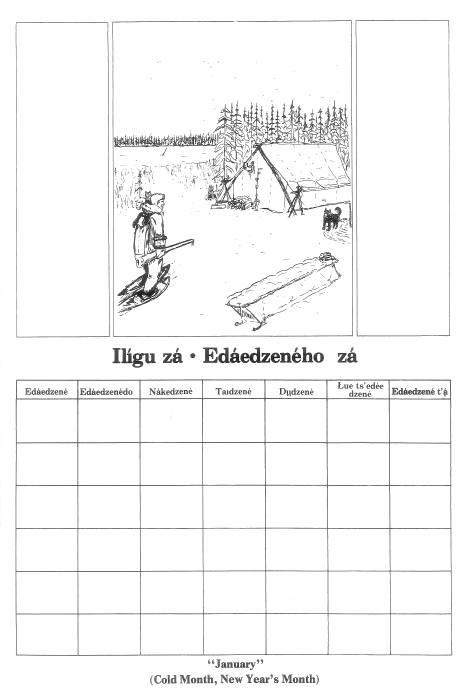
This text is a blank calendar with spaces to fill in the days anew each year. Illustrations and each month’s Dene name in both Dene and English mark each page, along with the days of the week in Dene language.
Ilı́gu zá, Edáedzeného zá January, Cold month, New Year’s month
Tłı̨chédé zá, Sa nek’ǫ́ne zá February, Dog wıggles hıs stıff taıl month, Short month
Det’ǫneho zá March, Month when eagle looks for food
Naeda zá Aprıl, Easter Month
Eghé zá May, Month when bırds lay theır eggs
Tsá kats’enı̨wę zá June, Beaver Huntıng Month
Įhbé July, Summer Month
Ek’a zá August, Month when anımals are fat
Egǫ́chı̨ ghǫ zá September, Moose huntıng month
Bek’e łue dats’ehté zá October, Month for storıng fısh
Ɂehdzo zá November, Trappıng Month
To yatı̨ zá December, Month of Chrıstmas
Access this Resource:
Available from the Ɂehdzo Got’ı̨nę Gots’ę́ Nákedı archives. Contact This email address is being protected from spambots. You need JavaScript enabled to view it. for access and see the Release and User Agreement form on the database home page.
Fort Franklin Slavey Language Program. Dene Sa Ɂerı̨ı̨htł’é. Northwest Territories Department of Education and Chief Jimmy Soldat School, n.d.
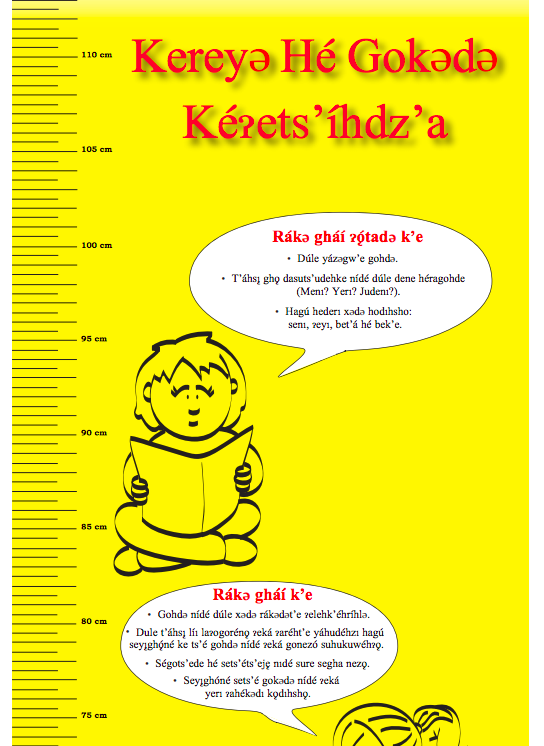
North Slavey Grow Chart, Kereyǝ Hé Gokǝdǝ Kéɂets’ı́hdz’a
This is a monolingual growth chart with cm measurements for different heights of children and corresponding images of different age groups learning to talk. For example, the baby at the bottom says, “Dúle duká ɂadehsı̨ (oo, goo, bababa)"
Read more resources from the Northwest Territories Literacy Council: https://www.nwtliteracy.ca/resources/indigenous-languages-and-literacies
Access this Resource:
Northwest Territories Literacy Council. “North Slavey Grow Chart, Kereyǝ Hé Gokǝdǝ Kéɂets’ı́hdz’a.” Family resource poster, n.d.
Sahtú Godé Dáhk’é, Place of Storıes
Designed by Rob Kershaw.
Contributors: Alfred Masuzumi, Rodger Odgaard, Gayle Strikes With a Gun, Henry Tobac, and Bella T’Seleie, along with Deborah Simmons (from acknowledgments).
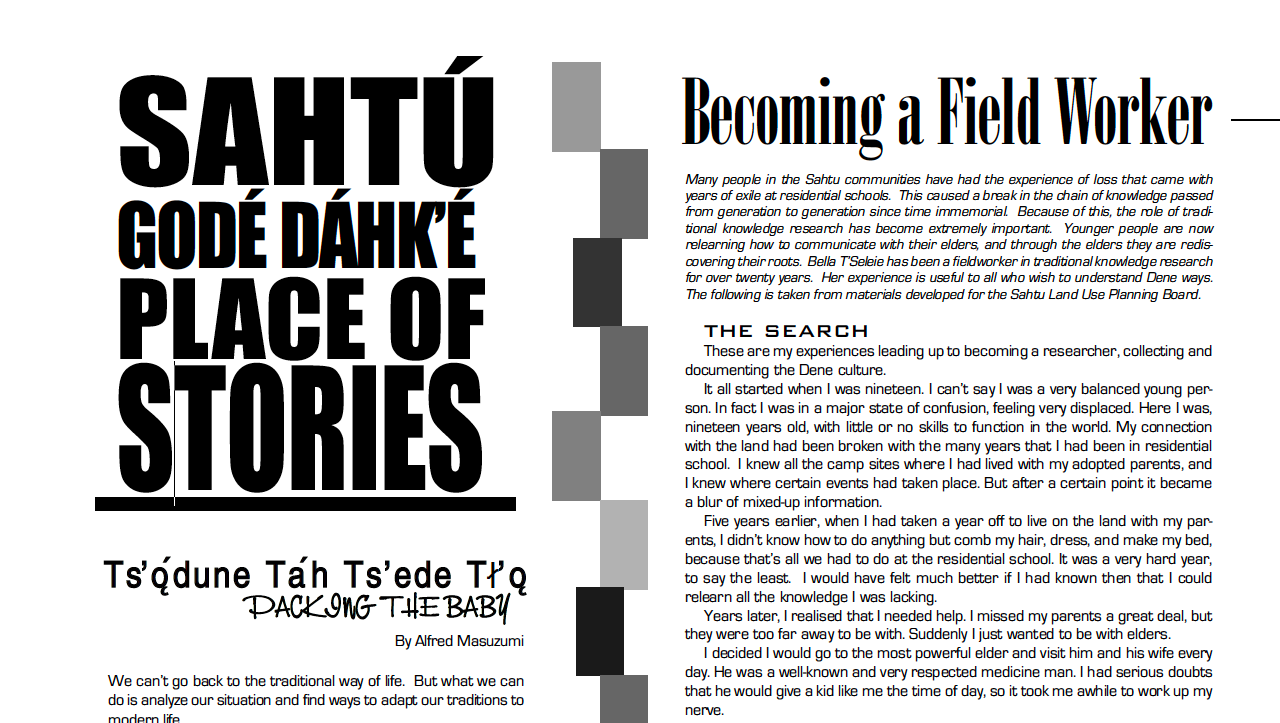
This magazine is meant as a supplement to the Mackenzie Valley Viewer, an online magazine for writing, photography, and art, accepts submissions in Dene (syllabics or Roman orthography), French, and English. Alfred Masuzumi explains in the first article that the writing is “a starting point for honest discussion,” to “analyze our situation and find ways to adapt our traditions to modern life.” He talks about Dene protocols, age and intergenerational responsibilities, and Bella T’Selei speaks of listening, silence, and Dene communication skills. Deborah Simmons finished off the first magazine with acknowledgments and thanks.
Search for other issues of Sahtú Godé Dáhk’é, Place of Storıes on this database.
Access this Resource:
Access a PDF by clicking on the attachment link at the bottom of the page.
“Sahtú Godé Dáhk’é, Place of Storıes.” Supplement to Mackenzie Valley Viewer, Fort Good Hope, September 2000.
Sahtú Godé Dáhk’é, Place of Storıes
From the acknowledgments: “This special issue of Sahtú Godé Dáhk’é was produced with the assistance of Alfred Masuzumi and Rose McNeely. Susan McKenzie of the Sahtú Land Use Planning Board created the map. Rob Kershaw and Anne Marie Jackson provided help with layout and design.”
This edition includes stories from:
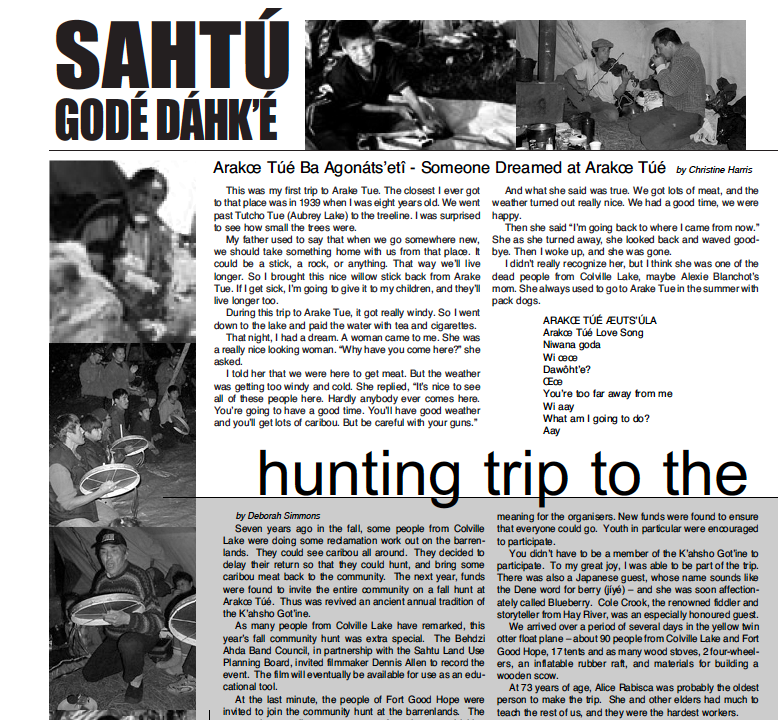
Christine Harris. Arakə Túé Ba Agonáts’etî, Someone Dreamed at Arakə Túé
Deborah Simmons. Hunting Trip to the Barrenlands.
Gabe Kochon, Fort Good Hope (Interview narrative, transcribed and translated by Rose Kochon). K’î əlá, Birch Canoe.
Alfred Masuzumi. Y’ak’e, Heaven and Ts’o̜dun Rákoyə, Chıid’s play.
Charlie Tobac. Beauty of the Land.
Rose Kochon (series of quotations from interviews). Voices from K’áhbamñ Túé.
Many of these stories are about a journey to Arakœ Túé, how to ask properly for good hunting conditions, and some of the qualities of the place, lessons, and stories that took place there. People who participated in the journey talked about visions, their memories of going to Arakœ Túé as children, and the lessons they had learned about it from elders.
It also features a number of place-names provided by Gabe Kochon and Alfred Masuzumi, assisted by Rose McNeely.
Arake Túé (Inuit Lake) – Horton Lake
Bedzi Rayú (Female Caribou Ridge) – Belot Ridge
K’áhbami̜ Túé (Ptarmigan Net Lake) – Colville Lake
Líhsigóhlin (Red Mud Place) – a place on the Anderson River where red ochre is found
Œyonih Ki̜ (Phalarope Dome) – Maunoir Dome
Sháli Túé (Shawl Lake) – Kilekale Lake
Táhgun (translation unknown) – Unnamed creek
Táshín Túé (Stump Lake) – Lac des Bois
Search for other issues of Sahtú Godé Dáhk’é, Place of Storıes on this database.
Access this Resource:
Download a PDF by clicking on the attachment link at the bottom of the page.
“Sahtú Godé Dáhk’é, Place of Storıes.” Supplement to Mackenzie Valley Viewer, Fort Good Hope, October 2000.
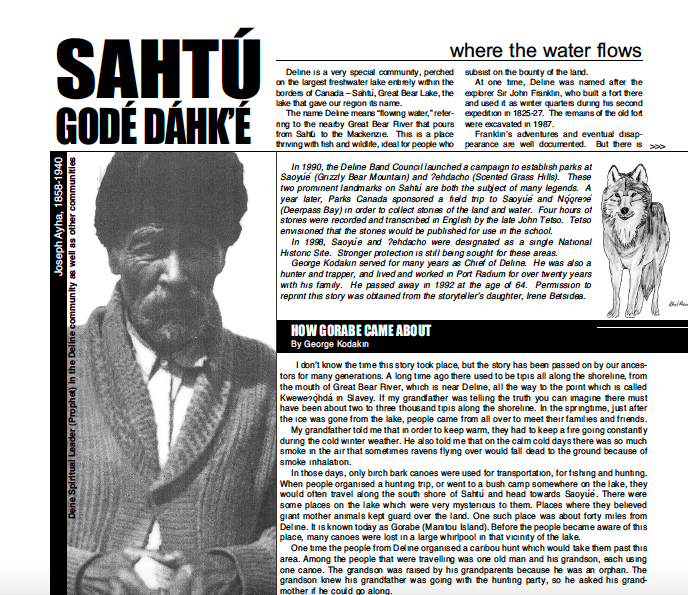
Sahtú Godé Dáhk’é, Place of Storıes
From the acknowledgments: “Albertine Ayha and Sean Lynch provided support and assistance in Deline. Thanks again to Robert Kershaw for doing layout. Thanks also to Alfred Masuzumi for helping to gather the stories, and for donating his illustrations. Alfred has recently returned to Fort Good Hope after living for two years in Deline with his late wife Sarah, who was born in that community.”
This edition includes many stories from/about Délı̨nę, discussing its origins, the founding of Saoyúé-Ɂehdacho park and a series of stories recorded and transcribed there by John Tetso, and National Historic Site designation. One story was told by George Kodakin, who passed away in 1992, but his daughter Irene Betsidea gave permission for a reprint.
Stories include:
George Kodakin. How Gorabe Came About.
Peter Baton. How Saoyúé Got ıts Name.
Where the Water Flows (a history of Délı̨nę, no author)
Sahtú and the Atomic Bomb (based on Village of Widows, 1999)
Chief Richard Kochon, translated and transcribed by Rose McNeely. Letter—Barrenlands Hunt September.
Dora Gully (syllabic text, the late author from Déline wrote for Dene Nation in 1984)
This edition notes that elders have requested syllabic texts, since they often cannot read and write in Sahtú Roman Orthography.
Search for other issues of Sahtú Godé Dáhk’é, Place of Storıes on this database.
Access this Resource:
Download a PDF by clicking on the attachment link at the bottom of this page.
“Sahtú Godé Dáhk’é, Place of Storıes.” Supplement to Mackenzie Valley Viewer, Fort Good Hope, November 2000
 Phone: 867-374-4041
 Email: