
Water hearts and cultural landscapes: Practical understanding and natural resource management in the Northwest Territories, Canada
This dissertation explores how socio-cultural and political practices enable people to become institutional bricoleurs in resource management.
Abstract:
The Canadian North finds itself in a period of Canadian history with unprecedented levels of social and environmental complexity, political uncertainty and economic change. Within the Mackenzie River valley of the Northwest Territories, major industrial resource development projects are underway. At the same time, innovative natural resource management (NRM) governance institutions are being proposed. This dissertation explores how socio-cultural and political practices enable people to become institutional bricoleurs in resource management. From Déline, Northwest Territories, I examined how outside resource managers from federal and territorial governments, environmental non-government organizations, and aboriginal community leaders perceive, negotiate and practically apply one another's diverse understandings of NRM. This research is based on my active working group participation in two locally-driven collaborative projects: the Great Bear Lake Watershed Management Plan (GBLMP) and the long-term protection of an aboriginal cultural landscape for Sahoyúé-Ehdacho (Grizzly Bear Mountain - Scented Grass Hills National Historic Site). Within these cases of emergent community-based co-management, an ethnographic approach was pivotal in exploring new approaches to NRM arising from the dynamic relations between local and outside institutional actors. Recognition and incorporation of the notions of difference and practice establishes a space for potential positive social change. I suggest that the term `practical understanding' encapsulates how communities and outside agencies together perceive NRM. In the process of developing the GBL watershed management plan, creating a relational space resulted in shared understanding of resource management through narratives such as the story of the Water Heart. For shared understanding to be applied in the development of new formal institutions, however, it must be reconsidered as practical understanding and part of strategy in social practice. The political process of protection for Sahoyúé-Ehdacho demonstrated that strategies as engagement and practical disengagement are integral to practical understanding. The significance of this perspective of NRM is that it offers a cultural framework with which to explore institutional hybridity. Such a framework requires an examination of the ways in which we perceive, conceive and actively apply culture and power relations in resource management planning that is predominated by the increasingly globalized nature of natural resources.
Access this Resource:
This dissertation can be requested from ProQuest.
Caine, Kenneth James. Water hearts and cultural landscapes: Practical understanding and natural resource management in the Northwest Territories, Canada. Doctoral Thesis, University of Alberta, 2008.
Annual Report on Official Languages 2006-2007
Every fiscal year, the Government of the Northwest Territories issues a record of measures taken to implement the Official Languages Act. Each report details developments in both French and Aboriginal language programming. Many programs focus on connecting youth with elders, training teachers, developing curriculum, and providing government services in as many languages as possible.
One excerpt from the 2007 report:
“In September 2003, the Minister Responsible for Official Languages tabled the GNWT’s Response to the Final Report of the Special Committee on the Review of the Official Languages Act. This document addressed, in detail, each recommendation and laid out a course of action over several years. In 2006-2007, a number of these actions were undertaken to further improve GNWT’s ongoing language programs and services.” (4)
Access this Resource:
The Government of the Northwest Territories makes reports from the last decade available here: https://www.ece.gov.nt.ca/en/services/francophone-affairs-secretariat/official-languages-annual-reports
Government of the Northwest Territories. Annual Report on Official Languages. Yellowknife: 2007.
Beyond Bureaucracy: Collaborative relationships in the transition to co-management – a case study in the Sahtu Region, Northwest Territories, Canada
From Abstract:
This study takes as its starting point the hypothesis that manager-harvester relationships are a key indicator of successful co-management processes. Interviews were conducted with senior resource managers from the Sahtu Region of northern Canada to obtain their assessment of evolving manager-harvester relationships before, during and after the establishment of co-management institutions. Interview narratives were analysed to shed light on changes and continuities in the participation of indigenous people in decision-making This led to the conclusion that the institutionalization of collaborative relationships within the bureaucratic framework of co-management has had a negative affect on indigenous participation. Nevertheless, the co-management regime was found to be surprisingly adaptive as a result of certain key continuities in the resource management system; a history of strong relationships between resource managers and harvesters, and a problem-solving approach by managers appeared to be stronger than the depersonalized and bureaucratic aspects of co-management institutions. Thus the study confirms the ongoing significance of social capital as a determinant of successful co-management.
Access this Resource:
Request this thesis from Stockholm University.
Carthew, Ruaraidh. Beyond Bureaucracy: Collaborative relationships in the transition to co-management—a case study in the Sahtú Region, Northwest Territories, Canada. Master’s Thesis, Stockholm University, 2007.
Aboriginal languages in Canada: Emerging trends and perspectives on second language acquisition
This paper uses data from 2001 and previous to present trends in Aboriginal Language use in Canada, namely, an overall drop in conversational ability, a decline in mother tongue population, and a rise in second language acquisition for Aboriginal languages. Additional findings (again, representing Canada but not necessarily smaller populations) include the fact that second language speakers are often younger community members rather than mother tongue population speakers.
For 2001, Norris lists the “North Slave (Hare)” total population as 1,030, with 165 second language speakers. For all speakers under the age of 25, 27% were Dene as a second language speakers – a proportion higher than that of any other age group. Norris identifies a few language groups which are growing due to second language acquisition, such as some Salish languages. While speakers may still be learning North Slavey, Norris labels the language definitively endangered. One sign of endangered language status, according to Norris, is a young population with a growing proportion of second language speakers over mother tongue speakers.
Access this Resource:
Read the full report from Statistics Canada.
Norris, Mary Jane. “Aboriginal languages in Canada: Emerging trends and perspectives on second language acquisition.”Aboriginal languages in Canada: Emerging trends and perspectives on second language acquisition.” Canadian Social Trends. Statistics Canada Catalogue no. 11-008 (2007): 19-28.
Language Nest Evaluation Report
This evaluation of Language Nests in the Northwest Territories is a detailed overview of the Indigenous language immersion programs that were folded into pre-existing licensed day cares and Head Start facilities beginning in 2003. The evaluation process had two steps: first, a workshop with language nest staff from all 18 nest sites (which included at least one from representative from each NWT language region). This was meant to introduce the staff to the purpose of evaluation and incorporate their feedback into the evaluation framework, which covered both process/program delivery and outcome/language acquisition.
The authors identify numerous strengths of the language nest program, primarily surrounding increased awareness of language and culture for participants and communities, willingness to pursue learning, and intergenerational transmission. Children, parents, elders, staff, and communities interacted positively and productively with the language nest program. The programs also encountered challenges, namely: a lack of central administrative support, staffing and turnover, unavailability of training, no core or multi-year funding, incomplete immersion, no curriculum, parental concerns about bilingualism confusing their children, and no evaluative standards. The Language Nest evaluation made numerous recommendations to help mitigate these concerns. At least two nests existed in the Sahtú region, including one in Délı̨nę and one in Fort Good Hope.
Access this Resource:
This report is not currently publically available.
Hume, Sharon, Deborah Rutman, and Carol Hubberstey. Language Nest Evaluation Report. Department of Education, Culture and Employment: Yellowknife, 2006.
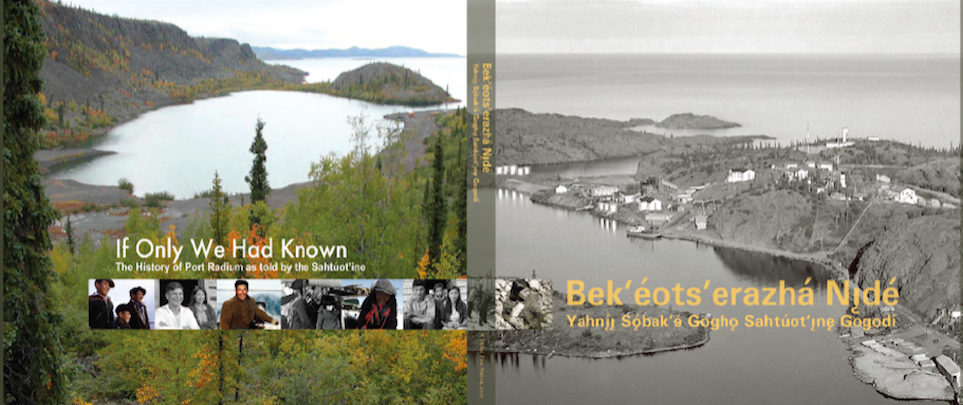
If only we had known: The history of Port Radium as told by the Sahtuot'ine
This book-length text’s release coincided with the 2005 report of the Canada-Délı̨nę Uranium Table. It emphasizes the Sahtúot’ı̨nę perspective on Port Radium, contextualized with local history and the personal and community impacts of the uranium mine.
Access this Resource:
This book is available from many Canadian University Libraries (e.g., University of Toronto). ISBN: 9780973772708.
Délı̨nę Uranium Team. If only we had known: The history of Port Radium as told by the Sahtuot’ine. Délı̨nę: Délı̨nę Uranium Team, 2005.
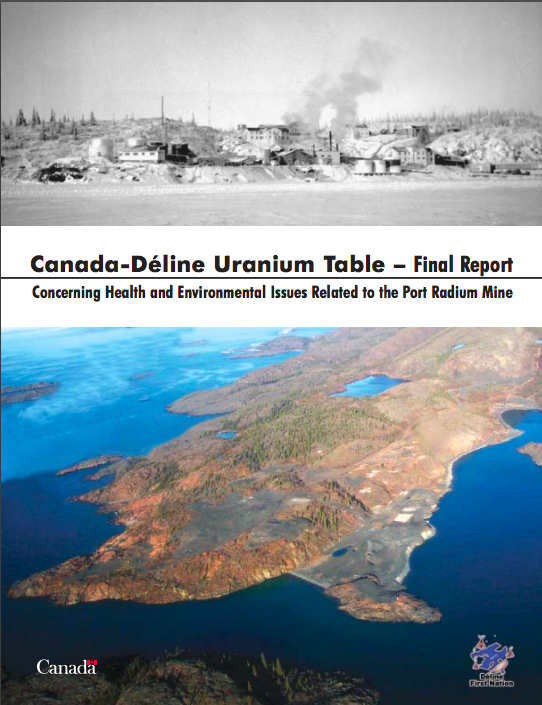
Canada-Deline Uranium Table Final Report
From Abstract:
The Canada-Deline Uranium Table (CDUT) was formed by the Deline First Nation and the federal government in 1999 to address community concerns about the environmental and health impacts of the Port Radium uranium and radium mine, which operated from 1931-1960 and whose activities were supported by workers from Deline. In the 1980s, people in Deline began to learn of the damages to human and environmental health that can be caused by radium and uranium mining, causing community members to fear for the safety of their land and traditional foods and to connect recent cancer suffering in the communtiy to past radium and uranium exposures. The CDUT Final Report describes the studies and activities carried out during Action Plan implementation and presents all associated findings and recommendations. Key findings include: the Port Radium mine was generally in compliance with contemporary regulations relevant to uranium milliing and mining; it is not possible to know for certain if the death or illness of any given individual was directly caused by radiation exposure; and healing activities focused on the affirmation of Dene culture and identity have proven helpful in the aftermath of this problem.
Access this Resource:
The PDF is available online.
Indian and Northern Affairs Canada, Health Canada, Natural Resources Canada, and Délı̨nę First Nation. Canada-Délı̨nę Uranium Table Final Report. Ottawa: Indian and Northern Affairs Canada, 2005.
Sahtú Regional Workshop on the Social Impacts of the Mackenzie Valley Gas Project
This report summarizes proceedings from a Sahtú workshop held in Norman Wells on September 30, 2005. It was the third of three workshops sponsored by the GNWT, held in Inuvik and Fort Simpson. Participants were asked to discuss the positive and negative impacts of the Mackenzie Valley Gas Project in four main areas: employment and income, housing, justice, and health and wellness. They discussed concerns about alcohol and drug use, violent crime, Elder abuse, and the well-being of youth, including youth who are not respectful of Dene traditions.
Access this Resource:
No PDF. A physical copy of this document was found at the University of Alberta Circumpolar Collection: Cameron Library, call number HN 104 S24 2005.
Lutra Associates. Government of the Northwest Territories-Sahtú Regional Workshop on the Social Impacts of the Mackenzie Valley Gas Project. Norman Wells, 2005.
Dene Ways of Respecting the Land and Animals
This project was initiated by the Sahtú Renewable Resources Board to explore the way of life of the Sahtúot’ine and to discuss Dene laws relevant for natural resource management. As the first inhabitants of the Great Bear Lake area, the Sahtúot’ine have certain resource management goals. In order to achieve these goals, government management agencies and industry must be made aware of these goals and begin to understand and respect the way of life of the Sahtúot’ine. The way of life of the Sahtúot’ine reflects their local knowledge, needs and rights as traditional keepers of the land. It is important to note that this may only be relevant to the Sahtúot’ine who reside in the Great Bear Lake area.
Access this Resource:
Modeste, Jane. Dene Ways of Respecting the Land and Animals. Délı̨nę: Délı̨nę First Nation, 2005.
Available from the Ɂehdzo Got’ı̨nę Gots’ę́ Nákedı archives. Contact This email address is being protected from spambots. You need JavaScript enabled to view it. for access and see the Release and User Agreement form on the database home page.
Wasáse: Indigenous pathways of freedom and action
The author contends that capitalism and the ways of life it enables are antithetical to Indigenous ways of being, and that a contemporary warrior must tactically resist the negative patterns of a modern, capitalist life. Rather than joining and working within colonial systems, he advocates for restructuring both one’s personal life and society using ancestral teachings and Indigenous ways of being.
Description:
The word Wasáse is the Kanienkeha (Mohawk) word for the ancient war dance ceremony of unity, strength, and commitment to action. The author notes, "This book traces the journey of those Indigenous people who have found a way to transcend the colonial identities which are the legacy of our history and live as Onkwehonwe, original people. It is dialogue and reflection on the process of transcending colonialism in a personal and collective sense: making meaningful change in our lives and transforming society by recreating our personalities, regenerating our cultures, and surging against forces that keep us bound to our colonial past."
Access this Resource:
Read the Google Book Preview.
Alfred, Taiaiake. Wasáse: Indigenous Pathways of Action and Freedom. Toronto, University of Toronto Press, 2005.
 Phone: 867-374-4041
 Email: