
Aboriginal languages and selected vitality indicators in 2011
This paper examines language vitality in Canada using the 2011 Census and National Household Survey data on mother tongue and conversational second language use. The Census of Population groups Aboriginal Languages into 12 families: Dene was measured as having 11,860 mother tongue speakers in 2011, lower than Cree (83,000) but higher than many others including Stoney, Blackfoot, and Innu. In addition, 67.9% of mother tongue Dene speakers reported using Dene most often at home, with a further 21.1% using it regularly in the home. Across Canada, people were more likely to speak their Aboriginal Language at home when they lived in a community (or census subdivision) where a high proportion of people shared that language. They were less likely to use it regularly if they moved to an area where most people had a different mother tongue, such as English or French. Between all Inuit, Métis, and First Nations communities in Canada in 2011, 21.7% of those able to conduct a conversation in an Aboriginal Language had acquired it as a second language.
Access this Resource:
Read the full text for free from Statistics Canada online.
Langlois, Stéphanie and Annie Turner. “Aboriginal Languages and Selected Vitality Indicators in 2011.” Statistics Canada Catalogue no. 89-655 (2014).
Cultural Vitality as Social Strength in Délı̨ne, Northwest Territories, Canada
Though Gordon does not use the phrase “Dene Ts’ı̨lı̨,” much of her dissertation is about the ways in which the people of Délı̨nę are preserving Sahtúot’ı̨nę epistemology with and for youth. She focuses on three primary areas of preservation or revitalization: first, on the land “heritage” activities, second, continuing Sahtúot’ı̨nę engagement with the Port Radium mine, and third, the tensions between elders and youth. She argues that the continued use of Sahtúot’ı̨nę epistemology in Délı̨nę helps the community heal from and avoid further social pathologies inflicted by ongoing colonization.
Access this Resource:
As of May 2018, this thesis has not yet been made available to the public.
Gordon, Sarah. Cultural Vitality as Social Strength in Délı̨nę, Northwest Territories, Canada. Doctoral Thesis, Indiana University, 2014.
Kǝdǝ Nıt’ǫ Benats’ adı́ - Xǝdǝ Rı́hęt’ǫ Herats’ǝ́dı (Remember the Promise)
From Introduction: "In March 2013, elders, Dene language specialists and others got together for a workshop to talk about how the story of species at risk can be understood through the language and stories of Dene and Métis. They agreed that the main people who need to work on these things are the present and future youth of the Sahtú Region. This book is dedicated to the workshop participants, and to the youth who are the future stewards of the land.
The first part of this book is a story, Remember the Promise, with Dene words. The meanings of those words can be found in the glossary (page 18). The second part includes more details about the workshop and the terms that were worked on in the dialects of Délı̨nę, Tulı́t’a, and K’asho Got’ı̨nę. The last part has more information about species at risk in the NWT.
Keeping the Dene language alive is part of keeping alive people’s sacred and respectful relationships with other living things. We hope that this book will encourage people to speak and understand the language of this land, the language of the ancestors. Through the language, we are sure to remember the promise."
Read more about this project, and access the full text in multiple languages, on the Remember the Promise page on the SRRB site.
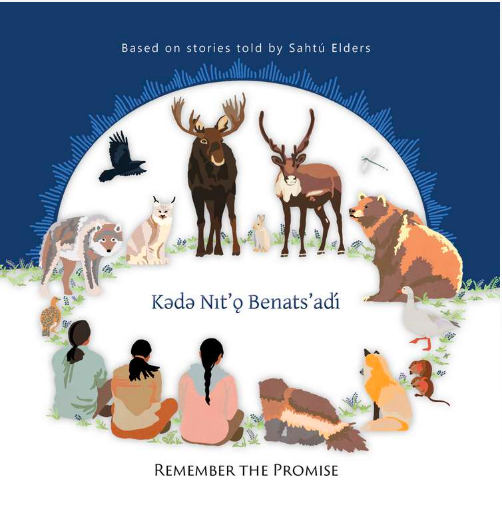
Sahtú Renewable Resources Board. Kǝdǝ Nıt’ǫ Benats’adı́, Remember the Promise. Compiled by Betty Harnum and Deborah Simmons, with a foreword by Michael Neyelle, 2014.
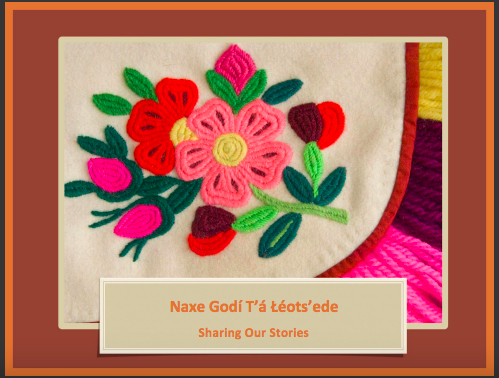
Naxe Godı́ T’á Łéots’ede, Sharing our Stories
This document is a public collections record featuring stories and photographs of objects from the Sahtú region. It was developed between 2013 and January 2014 by the Prince of Wales Northern Heritage Centre (PWNHC) and:
Elders: Maurice Mendo, Camilla Tutcho, and Vicki Orlias
Interpreter: Lucy Ann Yakelaya
Students: Dalton Takazo, Darren Horassi, Carmen McNeely, and Chantelle Orlias
Chaperones: Jessie Campbell and Richard Andrew
Sponsors: The PWNHC and Education, Culture, and Employment (GNWT)
Workshop Coordinator: Wendy Stephenson
Naxe Godı́ T’á Łéots’ede, Sharing our Stories documents a workshop wherein Elders, Students, and other Sahtú region participants gathered to give oral histories to objects in the Prince of Wales Northern Heritage Centre (PWNHC) collection. Objects such as mukluks were identified in as many different Sahtú dialects as possible, Délı̨nę, Tulı́t’a, and Fort Good Hope. Students listened to elders talk about their purpose and history, and Elder’s quotations were preserved by the PWNHC in this record.
Access this Resource:
The PWNHC has the full text of this book and other language communities' projects on their website: https://www.pwnhc.ca/collections/sharing-our-stories/
Prince of Wales Northern Heritage Centre and Sahtú Dene Elders. Naxe Godı́ T’á Łéots’ede, Sharing our Stories. Yellowknife, 2014.
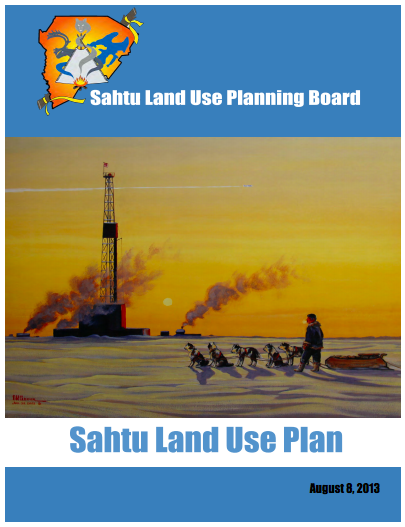
Sahtú Land Use Plan
The Sahtú Land Use Plan is the culmination of all of the mapping, consultation, and research that went into outlining the activities appropriate for the Sahtú Settlement Area following the SDMCLCA. The plan discusses conservation and development, and does not restrict or direct harvesting of Sahtú Dene and Métis. It pays special attention to the socio-cultural as well as the economic wellbeing of Sahtú residents, focusing on water resources as well as land use.
Access this Resource:
The Land Use Plan is available to the public on the Planning Board website.
Sahtú Land Use Planning Board. Sahtú Land Use Plan.Fort Good Hope, 2013.
From the ground up
This short paper provides an overview of Yukon, NWT, and Nunavut literacy non-profit organizations and coalitions. In general, these organizations attempt to work collectively, with families, communities, and intergenerational groups. Literacy programs depend on an interested party in the community working as a liaison, and usually are integrated into existing programming at libraries, early childhood programs, with health and recreation activities, or in other settings.
Abstract:
Community-based family literacy programmes tend to be neglected in a policy environment that ties funding for literacy programmes to work outcomes. In these circumstances many communities tackle their own local challenges, and the literacy coalitions in northern Canada are good examples of local communities taking a lead. Aggie Brockman discusses how they do it.
Access this Resource:
This resource is not publically available, but can be purchased from Fine Print.
Brockman, Aggie. “From the Ground Up.” Fine Print 36, no. 3 (2013): 8-11.
Annual Report on Official Languages 2011-2012
Every fiscal year, the Government of the Northwest Territories issues a record of measures taken to implement the Official Languages Act. Each report details developments in both French and Aboriginal language programming. Many programs focus on connecting youth with elders, training teachers, developing curriculum, and providing government services in as many languages as possible.
In 2011-2012, the Sahtu Members of the NWT Official and Aboriginal Languages Boards were Theresa Etchinelle and Dora Grandejambe, with an alternate of Ann Kochon Orlias.
Access this Resource:
The Government of the Northwest Territories makes reports from the last decade available here: https://www.ece.gov.nt.ca/en/services/francophone-affairs-secretariat/official-languages-annual-reports
Government of the Northwest Territories. Annual Report on Official Languages. Yellowknife: 2012.
Resilience to Ecological Change: Contemporary Harvesting and Food-Sharing Dynamics in the K’asho Got'ine community of Fort Good Hope, Northwest Territories
From Abstract:
This thesis examines how community hunting strategies and food-sharing networks facilitate social-ecological resilience to a decreased availability of barren-ground caribou in the K’asho Got’ine region of the Sahtú Settlement Area. It is based on collaborative research carried out with the Fort Good Hope Renewable Resources Council, including participant observation and interviews. I demonstrate that organizers of autumn community hunts (2007-2010) responded flexibly to ecological conditions (i.e. the availability of different species of game), and to community perspectives about the hunts, while working to address the broader needs of traditional knowledge education for youth and the food security of vulnerable demographics. A tradition of food-sharing has always been an important mechanism by which the latter need is met. Based on a comparison of two hunts in 2009 (a community hunt versus a series of household hunts), I find that vulnerable groups received meat to a greater extent after the community hunt in part through their exercising their eligibility for it through requests.
Access this Resource:
The University of Alberta has made this thesis accessible to the public.
McMillan, Roger C. Resilience to Ecological Change: Contemporary Harvesting and Food-Sharing Dynamics in the K’asho Got’ine community of Fort Good Hope, Northwest Territories. Master’s Thesis, University of Alberta, 2012.
Alpine Ice Patches and Shúhtagot’ine Land Use in the Mackenzie and Selwyn Mountains, Northwest Territories, Canada.
This paper describes the process of developing the NWT Ice Patch Study with Elders from Tulı́t’a, and the researchers’ efforts to incorporate traditional knowledge into their interpretation of archeological data. They interviewed Elders, ran science camps with Elders and youth, and involved oral histories and traditional land-use mapping in their fieldwork. The team spatially recorded oral traditions about hunting caribou in the mountains and on ice patches, contextualizing these histories with maps of place names, trails, hunting areas, resource-gathering areas, etc. Ice patches were of particular interest for the archaeological remnants of both historical caribou and their hunters.
During the study, the researchers recorded a number of Dene terms about Ice Patch conditions and other snow/ice terms (p 39).
Conditions of snow (zha)
zhahdewé “big snow,” a deep blanket of snow from a storm (a)
k’ahbahchoré “ptarmigan feathers,” light, fluffy snow (a)
shiré dry, flaky top layer of snow (a)
fileh loose, crystalline snow layer below shiré (a)
náegah powdery snow (a)
tahsilé hard snow (a)
zhaaɂurééłįh melting snow (a)
zhahtsele heavy, wet snow (a)
įzé slushy snow (a)
dazhá snow on tree branches (a)
zhatú water from melted snow (a)
Ice or snow features
zhaayáfelah ice patch (a)
łubee glacier (a)
łuugháh rough, broken ice on a river, making it difficult for travel (a)
p’enii frozen overflow, where water from below the snow or ice has seeped to surface and frozen (a)
tegahtú wet overflow (a)
Access this Resource:
Thomas D. Andrews, Glen MacKay, Leon Andrew, Wendy Stephenson, Amy Barker, Claire Alix and the Shúhtagot’ine Elders of Tulita. “Alpine Ice Patches and Shúhtagot’ine Land Use in the Mackenzie and Selwyn Mountains, Northwest Territories, Canada.” Arctic 65, no. 1 (2012): 22-42.
Towards a multi-layered understanding of place in Dene: An inter-generational and inter-disciplinary approach to Dene narratives.
The speakers begin by introducing themselves in their own languages. Fibbie introduces Délı̨nę, the community, geography, population, and other characteristics such as subsistence. She then moves to a discussion of Sahtú Dene language, and the age differences in language use. The community tries to mitigate intergenerational language loss with on the land programs for their children, both formal and informal, community-driven. Going on to the land during the summer is often lead by families, who still do a lot of harvesting on the land in their traditional regions. Ingeborg then discusses how people in Délı̨nę talk about place, from the point of view of a linguist. Tatti and Fink worked with several Elders and three youth participants to run a workshop in Délı̨nę in November 2012. The workshop had intergenerational participants work with audiovisual recording technology and Google Earth to record place name knowledge.
Abstract:
This paper highlights the benefits of a community-based approach (see Czaykowska-Higgins, 2009; Vallejos, 2014) in a language documentation project in the Dene community of Délı̨nę, Canada. It describes the collaborative efforts of a community researcher and an outside linguist to develop joint research interests and ground them with other community members in the specific cultural setting in order to benefit all parties. We first outline our project and the factors that contributed to the success of our research approach, focusing on an inter-generational workshop. We then introduce our results and demonstrate how the setup of the research brought forward crucial insights to the specific knowledge of place in Dene.
After identifying with elders of the community historically and culturally important geographic locations, including the traditional name attached to each location, we learned from the elders the stories behind the name of each location. The deeper meanings of these stories are known to people who lived on the land but are often unknown to younger generations. We developed a methodology bringing together elders and younger generations in an inter-generational workshop and actively engaging both in the research process in order to contribute to capacity building in language documentation and revitalization. The workshop was facilitated by a community researcher and held in Dene to enable the documentation of interactional patterns and communicative practices. At the same time the outside linguist trained youth participants in language documentation methodology (eg. multi-media recording, Google Earth), which they were able to perform independently by the end of the workshop. Since many of the younger generation are not fluent in Dene, English summaries were given throughout the workshop. These summaries allowed the younger generation to follow the content of the stories while also witnessing cultural protocols. Despite the challenges of the language barrier, the presence of the younger generation highly contributed to the motivation of the elders.
In analyzing the complex relationships between an outside researcher and community researchers from diverse generations and backgrounds as well as among community researchers we conclude that it was the research set up and the reciprocal relationships, as well as the observation of cultural protocols that proved to be crucial in the production and analysis of natural, reliable and validated language materials. In giving concrete examples and reflecting the challenges of our approach this paper contributes to the theory of developing effective research approaches that engage citizen scientists from various backgrounds.
Access this Resource:
Tatti, Fibbie and Ingeborg Fink. “Towards a multi-layered understanding of place in Dene: An inter-generational and inter-disciplinary approach to Dene narratives.” Presented at the 4th International Conference on Language Documentation and Conservation (ICLDC), 12 March 2015.
 Phone: 867-374-4041
 Email: