

Chikashshanompa'Ilanompohóli Bíyyi'ka'chi [we will always speak the Chickasaw language]: Considering the vitality and efficacy of Chickasaw language reclamation.
This dissertation engages with the stories of different types of Chickasaw language activists. Some young adult professionals have created careers centered around language revitalization; Chickasaw citizens who reside outside of the Nation also participate in language revitalization, and finally, many high school and university students study their language in school. The author works with all of these perspectives to talk about three themes helping Chickasaw language revitalization: “1) a raised critical Chickasaw consciousness, 2) the conception of Chickashshanompa’ as cultural practice, and 3) the (re)valuing of language learners” (11, from abstract).
Access this Resource:
This dissertation has been made available open access from the University of Arizona: https://pqdtopen.proquest.com/doc/1848289974.html?FMT=ABS
Chew, Kari A. B. Chikashshanompa'Ilanompohóli Bíyyi'ka'chi [we will always speak the Chickasaw language]: Considering the vitality and efficacy of Chickasaw language reclamation. Doctoral Thesis, University of Arizona, 2016.
Sahtú Environmental Research and Monitoring Forum 2013-2015 Update Report
From Report: “The Sahtú Environmental Research and Monitoring Forum was initiated in 2013 to support environmental research and monitoring by providing a venue for discussing plans and accommodating the priorities and traditional knowledge of Sahtú communities. Through fostering communications between forum members, which include community, regional, territorial and federal government representatives as well as industry representation, forum members hope to ensure that “environmental monitoring and research programs and projects in the Sahtú are coordinated and conducted in ways that reflect regional and community priorities, engage communities, value both western science and traditional knowledge, and support wise decision-making.”” Achievements from this reporting period included environmental research and monitoring workshops, research results workshops, and publications.
Access this Resource:
Read more about the SERM here: http://www.srrb.nt.ca/index.php?option=com_content&view=article&id=270&Itemid=843
Download the PDF from the attachment field at the bottom of this page.
Wenman, Christine. Sahtú Environmental Research and Monitoring Forum 2013-2015 Update Report. Tulıt’a: PlanIt North, 2015.
Annual Report on Official Languages 2014-2015
Every fiscal year, the Government of the Northwest Territories issues a record of measures taken to implement the Official Languages Act. Each report details developments in both French and Aboriginal language programming. Many programs focus on connecting youth with elders, training teachers, developing curriculum, and providing government services in as many languages as possible.
Highlights from 2014-2015:
The Sahtu Dene Council organized numerous cultural and on-the-land programs, such as seasonal hunts, spiritual gatherings and culture camps. All of these provide opportunities for youth to learn from Elders about traditional knowledge and customs as well as learn their language. Dene Literacy Classes were conducted, as were regular language classes at all four schools in the region. The SDC also recorded and distributed 200 USB Drives (memory sticks) with Elders’ stories.
Access this Resource:
The Government of the Northwest Territories makes reports from the last decade available here: https://www.ece.gov.nt.ca/en/services/francophone-affairs-secretariat/official-languages-annual-reports
The 2014-2015 report PDF is available here: https://www.ece.gov.nt.ca/sites/ece/files/resources/official_languages_report_2014-15.pdf
Government of the Northwest Territories. Annual Report on Official Languages. Yellowknife: 2015.
Northern Dene Languages: Use them or lose them
This paper assesses the state of Northern Athabaskan languages internationally, and examines language policy at the federal, state/province, and regional/local levels. It notes Sahtú and NWT policy initiatives such as the regional and territorial strategic plans, but comments that a dearth of evaluation has made it difficult to assess the impacts of these initiatives. The authors present many alternative strategies to address the dangers of language loss, including the following.
For individuals, communities, and regions (p. 15)
1. Athabaskan families should make more use of Arctic Athabaskan languages at home;
2. Communities should create more Arctic Athabaskan language learning environments in which elders, children, and youth can interact;
3. Current and emerging leadership should increase their use of Arctic
Athabaskan languages in public settings as much as possible; and
4. First Nations governments and organizations could require greater use of Arctic Athabaskan languages in their operations.
For territories and states (p. 17)
1. Dedicate long-term funding for Arctic Athabaskan language programs for daycares and pre-schools;
2. Amend territorial and state curricula to make Arctic Athabaskan language proficiency a requirement for high school graduation;
3. Territorial and state governments should develop structures to support public sector employees’ Arctic Athabaskan language learning, through the use of instructors, course material, and leave with pay;
4. Require industry to negotiate the use of Arctic Athabaskan languages in appropriate workplaces.
For Canada and the United States (p. 20)
Write a “Dene Language Accord” that “supports Athabaskan language use as well as French and English.”
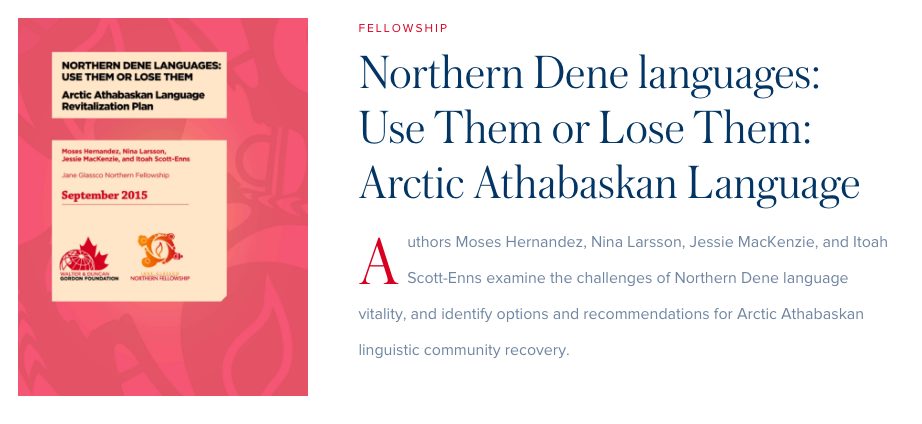
Access this Resource:
This paper is made available open access by the Gordon Foundation at this link: http://gordonfoundation.ca/resource/northern-dene-languages-use-them-or-lose-them-arctic-athabaskan-language/
Hernandez, Moses, Nina Larsson, Jessie MacKenzie, and Itoah Scott-Enns. Northern Dene Languages: Use them or lose them, Arctic Athabaskan Language Revitalization Plan. Toronto: Walter & Duncan Gordon Foundation, 2015.
Shutaot’ine Intro
The first version of Shutaot’ine Intro, an app for both Android and Apple, was released on May 11, 2012. The app offers vocabulary and phase options to begin with. They are: Food, Body, Words, Buildings, Actions, Conversations, More, Order, Time, Days, Months, Numbers, Money, Quantity, Animals, Colors, Commands, Dene, Family, TPR Vocab, TPR, Song, and Introductions. Within each category, options let you “learn,” or take a lesson, play “games” of different levels, or take “quizzes” in listening, speaking, and reading.
From App Description:
Danet’e! The Government of the Northwest Territories Department of Education, Culture and Employment, Yamozha Kue Society and the Sahtu Divisional Education Council are delighted to present a North Slavey language app available on the Google Play store. Shutaot’ine Intro offers language learning, practice, games and quizzes in many everyday categories such as food, actions, conversation, family and introductions. Learn your language and surprise your Elders! Mahsi cho.
Access this Resource:
To use this application, download it for free from one of the following links:
Google Play (Android devices): https://play.google.com/store/apps/details?id=com.languagepal.androidjessee_north_slavey&hl=en_GB
The App Store (Apple devices): https://itunes.apple.com/NZ/app/id524858939?mt=8
Yamózha Kúé Society, Northwest Territories Department of Education, Culture and Employment, and the Sahtú Divisional Education Council. Shutaot’ine Intro. Mobile Device Application. Version 1.1, December 15, 2015.
Dene, A Journey
Dene, a Journey is a two-season documentary series created by Yellowknife-based filmmaker Amos Scott, broadcast on APTN (Aboriginal Peoples Television Network) in 2013 and 2015. Tagged as a "land-based cultural adventure show," the series profiles young urban Dene who seek to reconnect with their Indigenous cultural heritage and traditional territory. Two episodes feature youth with Sahtú roots: in Season 1, Episode 6, Juno Award-winning musician Leila Gilday learns to tan a moosehide in Délı̨nę; in Season 2, Episode 8, Vancouver-based Eugene Boulanger goes on a hunting trip up the Keele River into Shúhtaot'ı̨nę territory with relatives.
Watch Season 6, Episode 1:
Dene A Journey Season 1, Episode 6- Dene Today and Tomorrow from Dene A Journey on Vimeo.
Access full episodes:
http://deneajourney.com/episodes/season-1/
Scott, Amos. Dene, A Journey. Documentary Series. Yellowknife: Dene A Journey, 2015.
A Language Survey of Northern Métis Languages: A Community-Based Language Revitalization Project
Saunders’ research uses a Community-based language revitalization approach to discuss the languages practices and attitudes of Northern Métis language communities, in the region North of Slave Lake. Saunders worked closely with the North Slave Métis Alliance, and distributed a survey to Métis people in Yellowknife and Fort Providence. The author found that the language was a unique variety of French, but that language shift is taking place rapidly.
From Abstract:
The purpose of the thesis is two-fold: to document the results of a language survey of Northern Métis languages which examines the language practices and attitudes of those Northern Métis people who participated, and to reflect upon the research process by examining the assumptions I bring to the research and my role and the role of other Masters level researchers in language revitalization projects. The research presented here has been conducted within the Community-based language revitalization (CBLR) research model (Czaykowska-Higgins 2009), a model which can be a powerful way to frame linguistic research and which is increasingly called upon when undertaking language revitalization projects. This thesis addresses the application of CBLR practices to a language revitalization project undertaken in collaboration with the North Slave Métis Alliance in the Northwest Territories, Canada. Along with positioning myself in the research, I provide an in-depth description of the historical, political, and social landscape in which the research takes place. My epistemologies and the CBLR model are informed by feminist and Native American methodologies, as well as participatory, participatory-action and action frameworks. Through this lens, I reflect on the academic context of language revitalization and offer my own model of collaborative language research which builds upon work done by Leonard & Haynes (2010). Applying this model, I present the results of the North Slave Métis Language Survey, conducted in 2013 in collaboration with the North Slave Métis Alliance. This thesis contributes to the body of work on Métis languages, and is the first to thoroughly examine and document the language practices of Métis people of the NWT. It also contributes to the growing body of work on CBLR research.
Read other University of Victoria Language Revitalization MA Theses from Laura Tutcho and Fibbie Tatti.
Access this Resource:
This thesis has been made available for free by the University of Victoria at this link: http://hdl.handle.net/1828/6152
Saunders, Susan Jane. A Language Survey of Northern Métis Languages: A Community-Based Language Revitalization Project. Master’s Thesis, University of Victoria, 2015.
The Wind Waits For No One: Nı̨hts’ı Dene Ası̨́ Henáoréhɂı̨́le Ǫt’e: Spirituality in a Sahtúgot’ı̨nę Perspective
Fibbie Tatti’s thesis explores Sahtúgot’ı̨nę spirituality: it describes and defines spirituality “from the perspective of the Sahtúgot’ı̨nę, distinguishing spirituality from concepts such as worldview, culture, and medicine power” (iii, abstract). Spirituality is an essential component of Dene education, Tatti writes. In documents like the Dene Kedǝ curriculum (1993) inclusion of spirituality (which makes up one quarter of the curriculum, along with relationships with land, people, and self) is important but difficult, because spirituality is different for different Indigenous peoples, and means different things.
Teaching on the land, for the Sahtúgot’ı̨nę, is paired with ceremony: feeding the fire, for example. Ceremonies are still practiced but gradually less understood, in part due to language loss. Each ceremony must be contextualized by history an, and the Elders explain this in a language that fewer and fewer youth can understand. Tatti also emphasizes the distinctions between worldview, culture, and spirituality, emphasizing a dependent relationship with animals and the cosmos—this fundamental relationship guides Dene behaviour, laws, and epistemology.
From Abstract:
The Sahtúgot’ı̨nę have lived in the Sahtú Region around Great Bear Lake since time immemorial. Our Elders believe that spirituality is the foundation for our language, culture and worldview and that it is essential for our language and culture to be taught in the context of spirituality. This thesis provides a description and a definition of spirituality from the perspective of the Sahtúgot’ı̨nę, distinguishing spirituality from concepts such as worldview, culture and medicine power. In keeping with our traditional ways of preserving and transmitting knowledge to future generations, the paper relies heavily on stories passed on to us from our Elders. The paper elaborates on key concepts of Sahtúgot’ı̨nę spirituality. First, like human beings, all animals on this earth have a living spirit or bets’ı̨nę́. Other entities on this earth - plants and trees, the water and the wind - are also living beings with their own yǝ́dı́ı. Specific geographic sites with a special significance to the Sahtúgot’ı̨nę are also said to be yǝ́dı́ı. The other key concept is the existence of three dimensions of existence and their inter-relationship which is crucial to the understanding of Sahtúgot’ı̨nę spirituality.
Read other University of Victoria Language Revitalization MA Theses from Susan Saunders and Laura Tutcho.
Access this Resource:
The University of Victoria has made this thesis available for free here: http://hdl.handle.net/1828/6113
Tatti, Fibbie. The Wind Waits For No One: Nı̨hts’ı Dene Ası̨ ́ Henáoréhɂı̨ ́le Ǫt’e: Spirituality in a Sahtúgot’ı̨nę Perspective. Master’s Thesis, University of Victoria, 2015.
Education Renewal and Innovation Framework: Directions for Change
This report captures a 3 year segment of an existing 10 year education renewal framework: a “comprehensive review and renewal of the education system in the NWT…. the first such undertaking since the early 1980s.” It includes several areas of action that highlight the continued importance of Aboriginal Language Culture Based Education (ALBCE), Elders in schools, enhanced support for teachers, post-secondary opportunities in the NWT, and community-driven education.
Access this Resource:
The Education Renewal Framework is available on the GNWT website as of May 2018.
Government of the Northwest Territories Department of Education, Culture and Employment. Education Renewal and Innovation Framework: Directions for Change. [Three-Year Education Renewal Action Plan], Yellowknife, June 2015.
Language, Distance, Democracy: Development Decision Making and Northern communications
The authors examine the relationship between connectivity, communications infrastructure, and democratic expression and civic participation. In an analysis of the Mackenzie Valley pipeline inquiry and the 2012-2013 Nunavut May River iron ore hearings, the Dalseg and Abele contend that communications technology is essential, but only functional given certain social and organizational conditions. These conditions include: local institutions for citizen mobilization, Indigenous language use, funding, and receptive public institutions.
The authors define a Northern problem they call “knowledge isolation,” which captures the difficulties of sharing essential information across Northern communities quickly, along with a dearth of opportunities to discuss collective decisions. They then turn to a history of northern communications technology, beginning after the Second World War. The introduction of radio in the 1950s through 1970s played an important role in Indigenous communities’ ability to mobilize politically and share knowledge. Television also expanded quickly after the Anik satellite permitted broadcasts to and from the north in 1973.
The Berger Inquiry was broadcast both on television and over CBC radio, along with topical bi-weekly documentaries on Our Native Land. Two Indigenous language broadcasters worked with CBC Northern Service and filed daily reports in seven Indigenous languages: Chipewyan, Dogrib, North and South Slavey, Gwich’in, and Inuktitut. Louie Blondin translated North and South Slavey. These translations were essential to the inquiry’s success, as they ensured that all communities understood the issues at play, and could hear their own perspectives echoed in other places.
From Abstract:
In a country as large as Canada, connectivity—whether by road, rail, radio, or the Internet—plays an important role in economic growth, political and social development, and civic engagement. The importance of communications infrastructure especially is evident in the northern two-thirds of Canada, where radio, television, and the Internet have been instruments of democratic expression and civic participation. As pressures for resource extraction mount, northern communities must respond to economic, social, and political challenges from a position of geographical and, more significantly, “knowledge” isolation. Northern community residents need effective, community-led channels of communication. Addressing these needs will require both social and technological innovation—which can, fortunately, proceed from an existing base of experience and community expertise. In this article, we analyze two moments in northern public policy discourse in which new communications media played a pivotal role in advancing democratic dialogue in northern Canada: the 1975-7 Mackenzie Valley pipeline inquiry, and the 2012-3 hearings into the Mary River iron ore project in Nunavut. Our goal is to advance understanding of the purposeful use of communications infrastructure to support the development of local understanding, citizen engagement, and opportunities for effective community participation in development decisions. We find that technological capacity is foundational, but effective only under specific social and organizational conditions, which include the existence of appropriate institutions at the local level for citizen mobilization and response, dominance of Indigenous language use by northern citizens, appropriate levels of funding, and receptive public institutions to and through which northern citizens can speak.
Access this Resource:
Download this paper for free from The Northern Review: http://journals.sfu.ca/nr/index.php/nr/article/view/473/yukoncollege.yk.ca/review
Kennedy Dalseg, Sheena, and Frances Abele. “Language, Distance, Democracy: Development Decision Making and Northern communications.” The Northern Review 41 (2015): 207-240.
 Phone: 867-374-4041
 Email: